Dimethylformamide → HCID 88821854, compound
Reaction equation

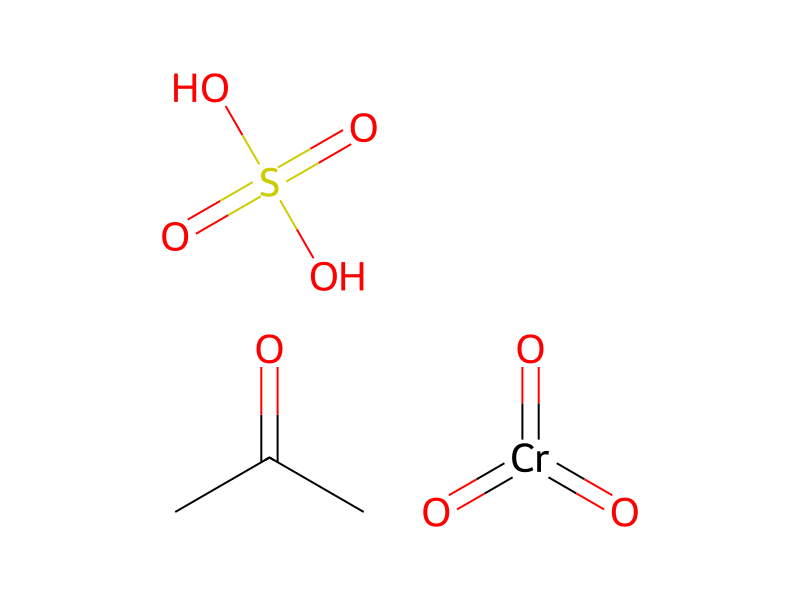
[C:1]([NH:4][CH:5]1[C:31](=[O:32])[N:7]2[C:8]([C:15]([O:17][CH:18]([C:25]3[CH:30]=[CH:29][CH:28]=[CH:27][CH:26]=3)[C:19]3[CH:24]=[CH:23][CH:22]=[CH:21][CH:20]=3)=[O:16])=[C:9]([CH2:13][OH:14])[CH2:10][S:11](=[O:12])[C@H:6]12)(=[O:3])[CH3:2].CN(C)C=O.CC(C)=O.OS(O)(=O)=O.O=[Cr](=O)=O>CC(C)=O>[C:1]([NH:4][CH:5]1[C:31](=[O:32])[N:7]2[C:8]([C:15]([O:17][CH:18]([C:25]3[CH:30]=[CH:29][CH:28]=[CH:27][CH:26]=3)[C:19]3[CH:20]=[CH:21][CH:22]=[CH:23][CH:24]=3)=[O:16])=[C:9]([CH:13]=[O:14])[CH2:10][S:11](=[O:12])[C@H:6]12)(=[O:3])[CH3:2]Participants
Reactant 3


Product 1

Reagents, catalysts & solvents 1

Conditions
- Temperature
- 20 °C
Procedure
To a stirred cooled (20° C.) solution containing 1.824 g. of benzhydryl 7-acetamido-3-hydroxymethyl-3-cephem-4-carboxylate-1-oxide dissolved in 35 ml. of dry dimethylformamide (DMF) mixed with 150 ml. of dry acetone there was added dropwise 4.5 ml. of Jones reagent. After stirring the mixture at 20° C. for 10 minutes the volume was reduced in vacuo to approximately one-half of the original volume, quenched with isopropanol, and poured into 100 ml. of ethyl acetate plus 100 ml. of saturated aqueous sodium chloride solution. The organic layer was separated and then washed successively with saturated aqueous sodium chloride solution, saturated aqueous sodium bicarbonate solution, saturated aqueous sodium chloride solution again and then dried over magnesium sulfate, filtered and evaporated to obtain benzhydryl 7-acetamido-3-formyl-3-cephem-4-carboxylate-1-oxide as an oil. The oil was dissolved in a mixture of 75 ml. of ethanol and 75 ml. of dry benzene. Then 1.39 g. of (carbethoxymethylene)-triphenylphosphorane was added as a solid with stirring. The mixture was stirred at room temperature for 1.5 hours, evaporated under reduced pressure and was purged with ethyl acetate and evaporated under reduced pressure to an oil. This material was then dissolved in 20 ml. of a mixture of 10 ml. of dry DMF and 10 ml. of dry acetonitrile, cooled to 0°-5° C., and then 1.976 g. of potassium iodide and 8 ml. of acetyl chloride was added. The mixture was stirred at 0°-5° C. for 5 minutes, and without cooling for 45 minutes, and evaporated under reduced pressure to an oil which was taken up in benzene. The benzene-oil mixture was washed successively with saturated aqueous sodium chloride solution, cold 5% hydrochloric acid solution, saturated aqueous sodium bicarbonate solution, 10% w/v aqueous sodium thiosulfate solution, saturated sodium chloride solution and then dried over magnesium sulfate. The solution was filtered, solvent removed under reduced pressure, and the residue was mixed with similar material and passed through a column containing 500 g. of silica gel (15% water) using a gradient elution technique with the product, benzhydryl 7-acetamido-3-(2'-ethoxycarbonylvinyl)-3-cephem-4-carboxylate coming off the column in a 12-17% ethyl acetate in benzene mixture. The product crystallized from a methylene chloride-ethyl ether mixture, m.p. 178°-179° C. The NMR, IR, and UV spectra were consistent with the assigned structure. The elemental analysis of the product was:
Workup
- additioncontaining 1.824 g
- customquenched with isopropanol
- additionpoured into 100 ml
- customThe organic layer was separated
- washwashed successively with saturated aqueous sodium chloride solution, saturated aqueous sodium bicarbonate solution, saturated aqueous sodium chloride solution again
- dry with materialdried over magnesium sulfate
- filtrationfiltered
- customevaporated
Sources & evidence
- ORD record
- ord-342803eca6294773bf31cd549b545324
- Source dataset
- uspto-grants-1977_12
- Patent number
- US04065620
Reaction notes
Loading…