Thionyl Chloride → HCID 13300848, compound
Reaction equation
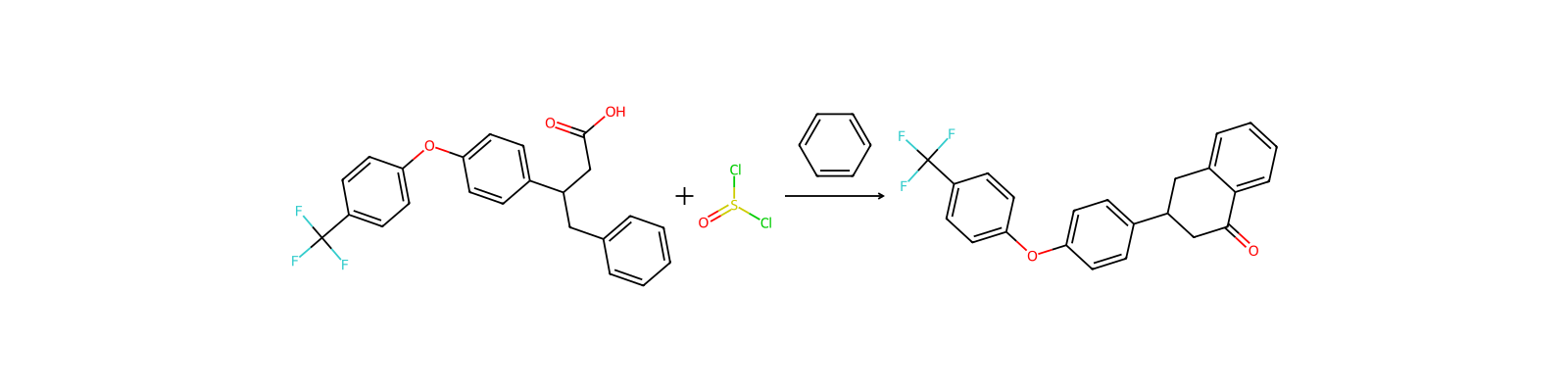
[F:1][C:2]([F:29])([F:28])[C:3]1[CH:27]=[CH:26][C:6]([O:7][C:8]2[CH:13]=[CH:12][C:11]([CH:14]([CH2:19][C:20]3[CH:25]=[CH:24][CH:23]=[CH:22][CH:21]=3)[CH2:15][C:16](O)=[O:17])=[CH:10][CH:9]=2)=[CH:5][CH:4]=1.S(Cl)(Cl)=O>C1C=CC=CC=1>[F:29][C:2]([F:28])([F:1])[C:3]1[CH:27]=[CH:26][C:6]([O:7][C:8]2[CH:13]=[CH:12][C:11]([CH:14]3[CH2:19][C:20]4[C:25](=[CH:24][CH:23]=[CH:22][CH:21]=4)[C:16](=[O:17])[CH2:15]3)=[CH:10][CH:9]=2)=[CH:5][CH:4]=1Participants
4
Reactant 2


Product 1

Reagents, catalysts & solvents 1

Procedure
3-(4(p-trifluoromethylphenoxy)phenyl)-4-phenylbutyric acid (23 g) was refluxed in benzene with thionyl chloride (46 ml) for one hour. The solution was then evaporated to dryness and the residue dissolved in benzene (23 ml). A solution of stannic chloride (23 g) in benzene (46 ml) was added at 0° with stirring. The solution was allowed to stir at 0° for 0.5 hr. Ice; water, diethylether and dilute HCl were then added sequentially. The ether extracts were further washed with aqueous potassium hydroxide and evaporated to give 3-(4-(p-trifluoromethylphenoxy)phenyl)tetralone m.p. 136°-137° (ethanol).
Workup
- customThe solution was then evaporated to dryness
- dissolutionthe residue dissolved in benzene (23 ml)
- additionA solution of stannic chloride (23 g) in benzene (46 ml) was added at 0°
- stirringto stir at 0° for 0.5 hr
- additionwater, diethylether and dilute HCl were then added sequentially
- washThe ether extracts were further washed with aqueous potassium hydroxide
- customevaporated
Sources & evidence
- ORD record
- ord-ddca9abd250f4496b7dfd262b8fdeefe
- Source dataset
- uspto-grants-1985_05
- Patent number
- US04520007
Reaction notes
Loading…