1-Indanone → 1-Chloro-3-(4-fluorophenyl)propan-2-one
Reaction equation

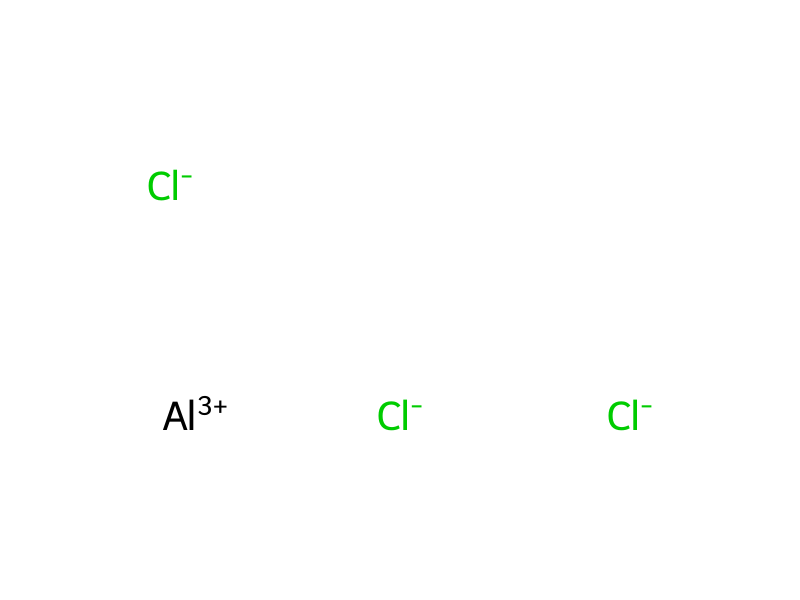
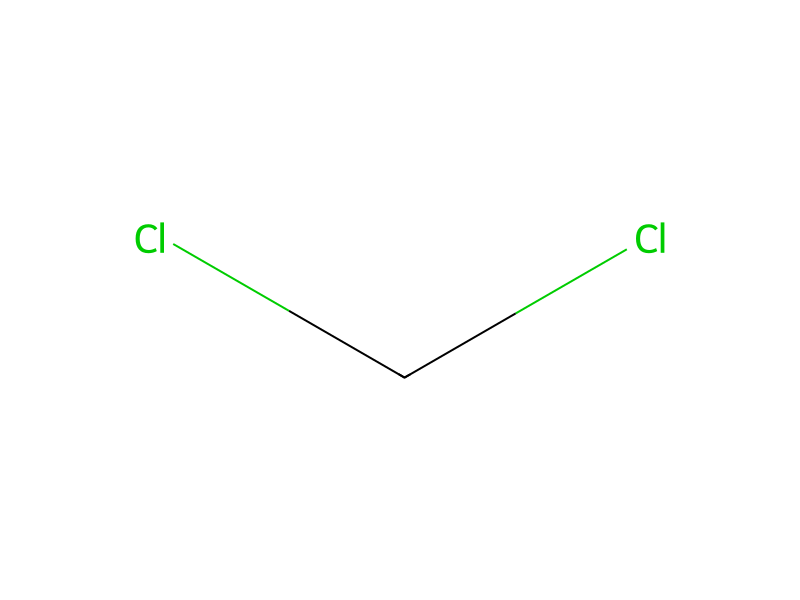
FC1C=C2[C:8](=CC=1)[C:7](=[O:11])[CH2:6]C2.FC1C=C2C(=CC=1)C1=NC=CC=C1C2.N1C=CC=C2CC3C(C=12)=CC=CC=3.C1(=O)C2C(=CC=CC=2)CC1.[Cl-].[Al+3].[Cl-].[Cl-].[Cl:53]CCC(Cl)=O.[F:59][C:60]1[CH:65]=[CH:64][CH:63]=[CH:62][CH:61]=1>C(Cl)Cl>[Cl:53][CH2:6][C:7](=[O:11])[CH2:8][C:63]1[CH:64]=[CH:65][C:60]([F:59])=[CH:61][CH:62]=1Participants
Reactant 7



Product 1

Reagents, catalysts & solvents 1
Procedure
The procedure used for the preparation of 5-fluoro-1-indanone is that of Olivier and Marechal (E. Bull. Soc. Chim. Fr. (1973) 3092-3095) with modifications. The conversion of the ketone to 7-fluoro-5H-indeno[1,2-b]pyridine followed the general procedure described by Parcell and Hauck (J. Org. Chem. (1963) 28, 3468-3473) for the preparation of 5H-indeno[1,2-b]pyridine from 1-indanone. ##STR122## Aluminum chloride (350 g, 2.62 mol) was covered with 650 mL methylene chloride and, while stirring under nitrogen, a solution of 3-chloropropionyl chloride (400 g, 3.15 mol, 300 mL) in 250 mL methylene chloride was added over 80 min. After 15 min., a solution of fluorobenzene (256 g, 2.66 mol, 250 mL) in 250 mL methylene chloride was added over 1 h 35 min. The reaction mixture was stirred, under nitrogen, at room temperature overnight (ca 18 h). The mixture was then poured onto 2.5 kg ice and transferred to a 4 L separatory funnel. After shaking well, the organic layer was removed and the aqueous portion was extracted with 2×50 mL methylene chloride. The combined organic extracts were washed with 3×200 mL saturated aqueous sodium bicarbonate and 1×200 mL brine, dried (MgSO4), and evaporated to leave an oil which crystallized on cooling. Recrystallization from 2 L hexane gave 325 g (67%). The filtrate was concentrated to 500 mL and cooled to provide another 42 g (9%) of product (46). ##STR123## 3-Chloro-1-(4-fluorophenyl)propanone (46) (366 g, 1.97 mol) and 2.2 L concentrated sulfuric acid were combined in a 5 L flask equipped with a mechanical stirrer and heated over a period of 80 min. to 120° C. and then maintained at that temperature for 30 min. Hydrogen chloride evolution began at about 80° C. The reaction mixture was then cooled to 20° C., poured onto 5 kg of ice in a 22 L flask equipped with a bottom drain and a mechanical stirrer, and extracted with 6×1 L chloroform. The combined extracts were washed with 2×1 L saturated aqueous sodium bicarbonate and 1×1 L brine, dried (MgSO4), and concentrated to leave a dark oil. Distillation gave the ketone, (47) 97.9 g (33%), bp 61°-66° C./0.15-0.2 mm, discolored by some dark material which was carried over during the process. ##STR124## A solution of 5-fluoro-1-indanone (47) (20.2 g, 0.135 mol), p-toluene-sulfonic acid monohydrate (0.015 eq, 390 mg), and piperidine (1.1 eq, 0.148 mol, 15 mL) in 300 mL toluene was refluxed under a Dean-Stark trap for 30 h. The reaction mixture was concentrated and distilled to provide the enamine, (48) 8.6 g (29%); bp 95°-100° C./1.5 mm. ##STR125## A solution of the enamine (8.6 g, 40 mmol) in 10 mL dry DMF was added all at once to a stirred solution of bromopropylamine hydrobromide (1.0 eq, 8.67 g) in 15 mL DMF. The stirred mixture was heated to 100° C. under nitrogen and then kept at that temperature for 4 h. The reaction mixture was poured into 60 mL cold 2N aqueous hydrochloric acid and extracted with 2×50 mL ethyl ether to remove any non-basic material. The aqueous solution was then covered with 50 mL ether, chilled, and basified using concentrated sodium hydroxide. After separating the organic layer, the aqueous portion was extracted with 2×50 mL ether and the combined extracts were washed with 1×50 mL brine, dried (MgSO4), and concentrated to leave 7.8 g of a dark oil. Distillation provided the tetrahydropyridine, 3.46 g (46%); bp 83°-86° C./0.15 mm. ##STR126## A mixture of the tetrahydropyridine (49) (3.19 g, 16.9 mmol), 10 mL xylene, 10 mL nitrobenzene, and 350 mg 10% palladium on carbon was refluxed for 4 h under a Dean-Stark trap under nitrogen. The reaction mixture was then cooled to room temperature and filtered through Celite, washing with ethyl acetate. The filtrate was extracted with 3×20 mL 2N aqueous hydrochloric acid and then the combined extracts were washed with 2×25 mL ethyl ether to remove non-basic material. Basification using solid potassium carbonate resulted in the precipitation of a dark green solid that was collected by filtration and washed well with water. This material 2.3 g (75%), was judged sufficiently pure by NMR to use in the next step. The material can further be purified by chromatography on silica gel using 30% ethyl acetate/hexane to give a yellow solid of (50) mp 80°-84° C.
Workup
- stirringThe reaction mixture was stirred, under nitrogen, at room temperature overnight (ca 18 h)
- customtransferred to a 4 L separatory funnel
- stirringAfter shaking well
- customthe organic layer was removed
- extractionthe aqueous portion was extracted with 2×50 mL methylene chloride
- washThe combined organic extracts were washed with 3×200 mL saturated aqueous sodium bicarbonate and 1×200 mL brine
- dry with materialdried (MgSO4)
- customevaporated
- customto leave an oil which
- customcrystallized
- temperatureon cooling
- customRecrystallization from 2 L hexane
- customgave 325 g (67%)
- concentrationThe filtrate was concentrated to 500 mL
- temperaturecooled
Sources & evidence
- ORD record
- ord-1538de2bdceb4cf3943990a87ec92c61
- Source dataset
- uspto-grants-1992_10
- Patent number
- US05153211
Reaction notes
Loading…