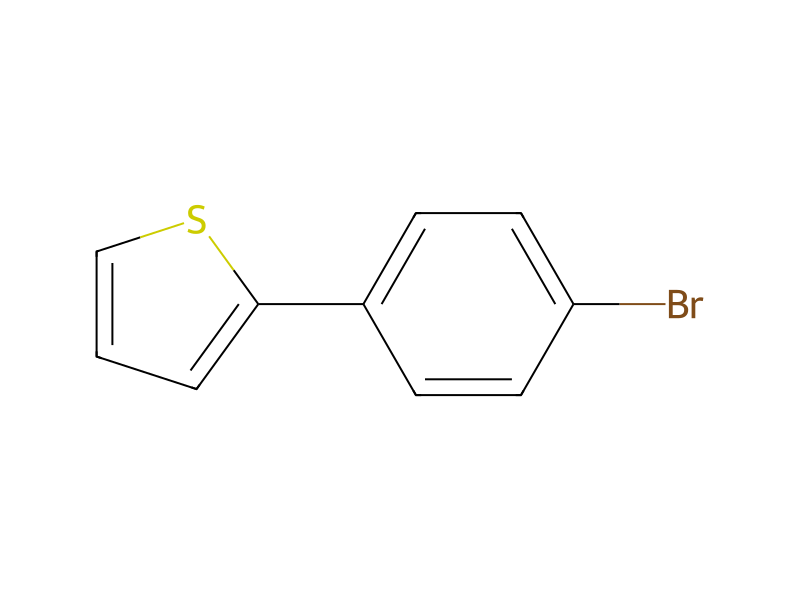
2-(4-Bromophenyl)thiophene → 2-(p-Bromophenyl)-5-(m-nitrophenylthio)thiophene
Reaction equation

[N+:1]([C:4]1[CH:5]=[C:6]([S:10]Cl)[CH:7]=[CH:8][CH:9]=1)([O-:3])=[O:2].[Br:12][C:13]1[CH:18]=[CH:17][C:16]([C:19]2[S:20][CH:21]=[CH:22][CH:23]=2)=[CH:15][CH:14]=1>C(Cl)(Cl)(Cl)Cl.[Fe]>[Br:12][C:13]1[CH:14]=[CH:15][C:16]([C:19]2[S:20][C:21]([S:10][C:6]3[CH:7]=[CH:8][CH:9]=[C:4]([N+:1]([O-:3])=[O:2])[CH:5]=3)=[CH:22][CH:23]=2)=[CH:17][CH:18]=1Participants
5



Procedure
To a solution of 21.2 g (0.112 mole) of m-nitrobenzenesulfenyl chloride in 160 ml of carbon tetrachioride were added 24.5 g (0.103 mole) of 2-(p-bromophenyl)thiophene and 0.1 g of iron powder. The reaction mixture was allowed to stand one week at room temperature. Evaporation of the solvent and recrystallization of the residue from 140 ml of ethyl acetate gave 17.6 g (44%) of 2-(p-bromophenyl)-5-(m-nitrophenylthio)thiophene, m.p. 120°-122° C.
Workup
- waitto stand one week at room temperature
- customEvaporation of the solvent and recrystallization of the residue from 140 ml of ethyl acetate
Sources & evidence
- ORD record
- ord-362563c75c84490c9f528892d920a28b
- Source dataset
- uspto-grants-1979_11
- Patent number
- US04174405
Reaction notes
Loading…