Sodium Citrate Dihydrate → Trisodium citrate
Reaction equation

O.O.[C:3]([O-:15])(=[O:14])[CH2:4][C:5]([CH2:10][C:11]([O-:13])=[O:12])([C:7]([O-:9])=[O:8])[OH:6].[Na+:16].[Na+].[Na+]>O>[C:3]([O-:15])(=[O:14])[CH2:4][C:5]([CH2:10][C:11]([O-:13])=[O:12])([C:7]([O-:9])=[O:8])[OH:6].[Na+:16].[Na+:16].[Na+:16]Participants
Reactant 1
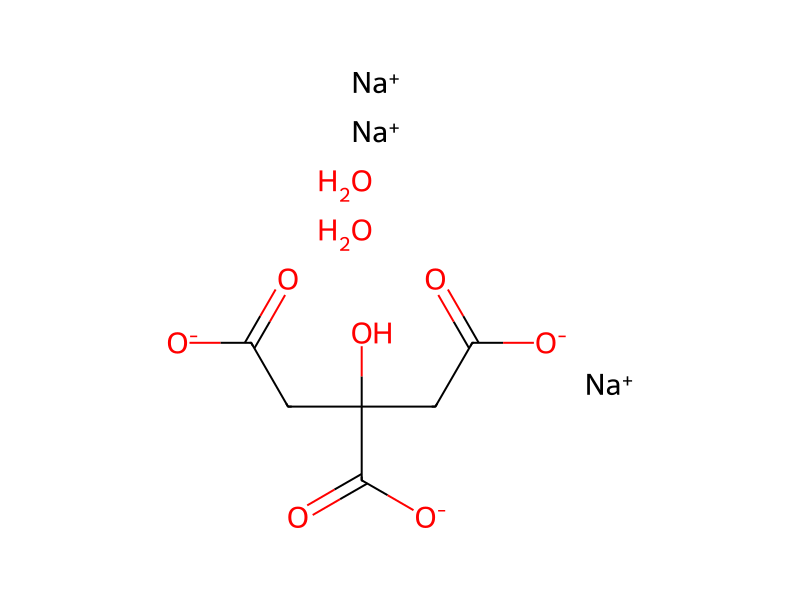
Product 1
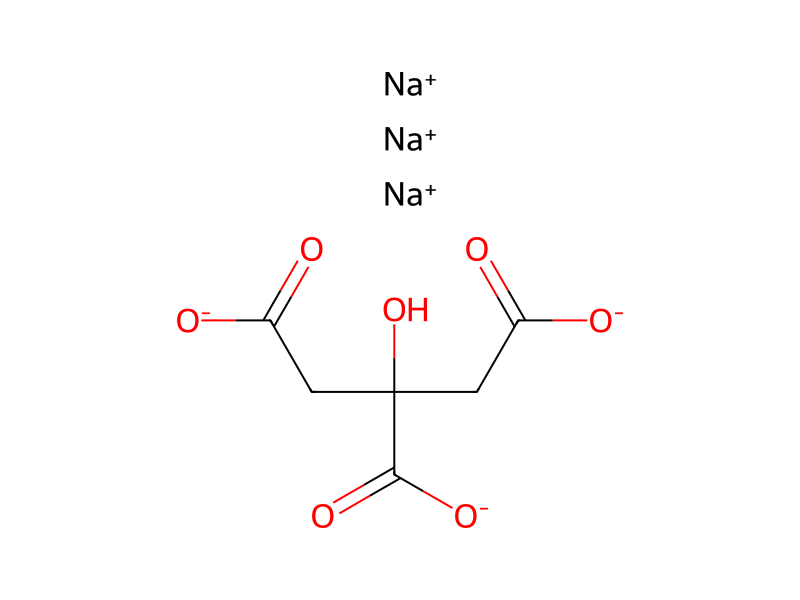
Reagents, catalysts & solvents 1

Procedure
Sodium citrate dihydrate was dissolved in nano-pure water to obtain 1.0% (w/v) sodium citrate. To the solution, 0.6% (w/v) and 0.4% (w/v) mannitol and L-leucine, respectively, were added and Ga(NO3)3.9H2O was dissolved to obtain 1.5% (w/v) Ga(NO3)3. The mixture was spray-dried at Tin/Tout=150/100° C., q=0.5 mL/min, and Patm=34 psi. The powder was collected under controlled temperature and humidity of 30° C. and <5% RH, respectively. The residual moisture content was 3.7% (w/w). 50 mg of the powder was encapsulated inside of a type 2 capsule and tested for particle size distribution using an Andersen cascade impactor (ACI) fitted with Turbospin® under a flow rate of 28 L/min. FPD<3.3μm and FPD<4.7μm were 9% and 11%, respectively. The MMAD was >6 μm and the ED was determined to be 33.6%. Gallium-containing compositions prepared with other suitable excipients were prepared and spray dried under the same conditions. The compositions of these gallium formulations are shown in Table 4. All of the solutions were prepared at pH7.0. The results of the aerosol testing as well as the residual moisture contents are shown in Table 5.
Sources & evidence
- ORD record
- ord-9713519ac4ee46f0b1ed36258e9e2233
- Source dataset
- uspto-grants-2014_01
- Patent number
- US08637090B2
Reaction notes
Loading…