Hydrochloric Acid → 3-Acetyl-4-methylthiobenzoic acid methyl ester
Reaction equation

[CH3:1][O:2][C:3](=[S:12])[C:4]1[CH:9]=[CH:8][C:7]([CH3:10])=[C:6](Br)[CH:5]=1.[CH2:13]([O:15]C([Sn](CCCC)(CCCC)CCCC)=C)[CH3:14].O.Cl>O1CCOCC1.C1C=CC([P]([Pd]([P](C2C=CC=CC=2)(C2C=CC=CC=2)C2C=CC=CC=2)([P](C2C=CC=CC=2)(C2C=CC=CC=2)C2C=CC=CC=2)[P](C2C=CC=CC=2)(C2C=CC=CC=2)C2C=CC=CC=2)(C2C=CC=CC=2)C2C=CC=CC=2)=CC=1>[CH3:1][O:2][C:3](=[S:12])[C:4]1[CH:9]=[CH:8][C:7]([CH3:10])=[C:6]([C:13](=[O:15])[CH3:14])[CH:5]=1Participants
7
Reactant 4


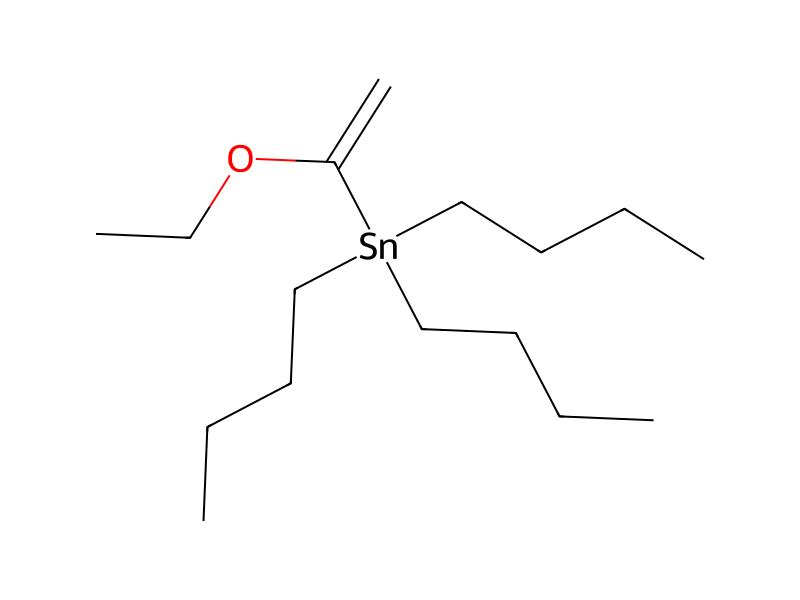

Product 1

Reagents, catalysts & solvents 2


Procedure
3-Bromo-4-methylthiobenzoic acid methyl ester (0.86 g), 1-ethoxyvinyl tributyl tin (1.39 ml) and tetrakis triphenylphosphinepalladium (IV) (0.15 g) were combined in dioxan (50 ml) and boiled for 24 h. The mixture was cooled, water (10 ml) and conc. hydrochloric acid (1 ml) added and the mixture stirred at room temperature overnight. Solvent was removed at reduced pressure, the residue dissolved in ethyl acetate and filtered through celite. The filtrate was evaporated to dryness and the residue triturated with hexane to give 3-acetyl-4-methylthiobenzoic acid methyl ester (0.45 g) as a yellow solid. m/z (API+): 225 (MH+).
Workup
- temperatureThe mixture was cooled
- customSolvent was removed at reduced pressure
- dissolutionthe residue dissolved in ethyl acetate
- filtrationfiltered through celite
- customThe filtrate was evaporated to dryness
- customthe residue triturated with hexane
Sources & evidence
- ORD record
- ord-ca2f8f265a104a84a2347392096d09e1
- Source dataset
- uspto-grants-2004_03
- Patent number
- US06699879B1
Reaction notes
Loading…