N,N-Dimethyl-1,3-propanediamine → P,P-bis(2,2-dimethyl-1-aziridinyl)-N-(3-dimethylaminopropyl)phosphinic amide
Reaction equation

[CH3:1][C:2]1([CH3:13])[CH2:4][N:3]1[P:5](Cl)([N:7]1[CH2:9][C:8]1([CH3:11])[CH3:10])=[O:6].[CH3:14][N:15]([CH3:20])[CH2:16][CH2:17][CH2:18][NH2:19]>C1COCC1>[CH3:1][C:2]1([CH3:13])[CH2:4][N:3]1[P:5]([N:7]1[CH2:9][C:8]1([CH3:11])[CH3:10])(=[O:6])[NH:19][CH2:18][CH2:17][CH2:16][N:15]([CH3:20])[CH3:14]Participants
4
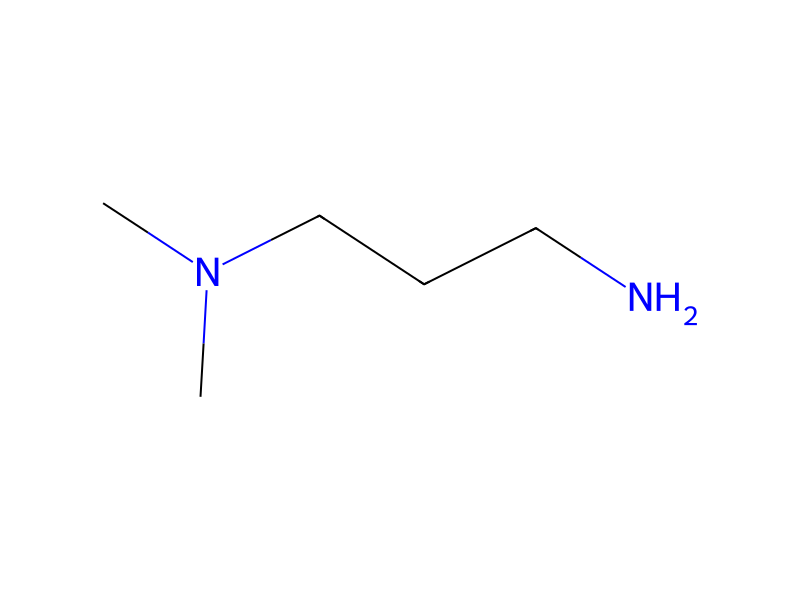



Conditions
- Temperature
- -40 °C
Procedure
A solution containing 0.025 moles of P,P-bis(2,2-dimethyl-1-aziridinyl)phosphinyl chloride in about 170 milliliters of THF was prepared in accordance with Example 1, chilled to -40° C. and treated, by slow dropwise addition, with a solution containing 0.026 moles of 3-dimethylaminopropylamine, in 25 milliliters of THF. The resulting slurry was stirred overnight at ambient temperature, filtered, the filtrate was concentrated by rotary evaporation, and vacuum distilled at 119° C./0.45 millimeter of mercury to produce a 40% yield of P,P-bis(2,2-dimethyl-1-aziridinyl)-N-(3-dimethylaminopropyl)phosphinic amide. NMR characterization confirmed the product was 99% pure. Elemental analysis confirmed the structure contained the following:
Workup
- customwas prepared in accordance with Example 1
- additiontreated, by slow dropwise addition, with a solution
- filtrationfiltered
- concentrationthe filtrate was concentrated by rotary evaporation, and vacuum
- distillationdistilled at 119° C./0.45 millimeter of mercury
Sources & evidence
- ORD record
- ord-90a0f3d7742b47f7ac28741abd2a5edd
- Source dataset
- uspto-grants-1989_12
- Patent number
- US04886790
Reaction notes
Loading…