Ethyl Acetate → 5-(Furan-3-yl)pyridine-3-carbaldehyde
Reaction equation

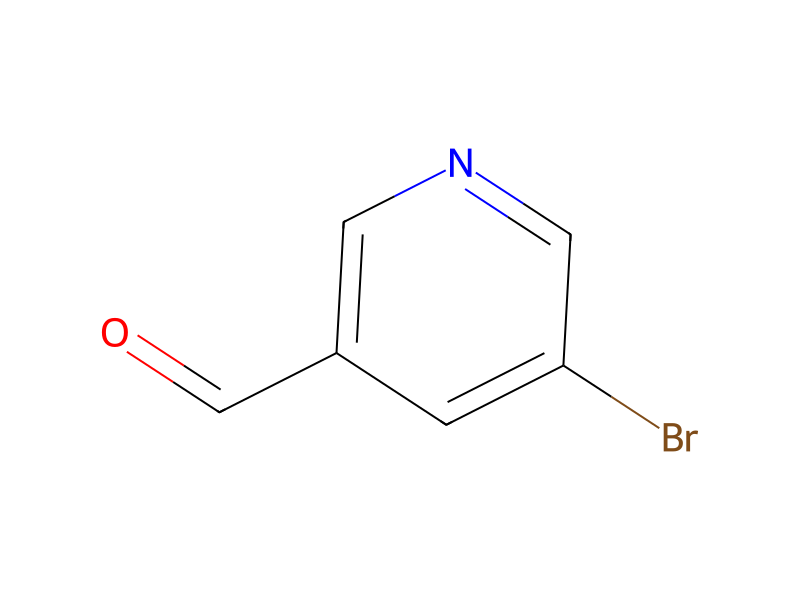
Br[C:2]1[CH:3]=[N:4][CH:5]=[C:6]([CH:8]=[O:9])[CH:7]=1.S1C=CC(B(O)O)=C1.C(=O)([O-])[O-].[Na+].[Na+].[C:24]([O:27][CH2:28][CH3:29])(=O)[CH3:25]>COCCOC.C1C=CC([P]([Pd]([P](C2C=CC=CC=2)(C2C=CC=CC=2)C2C=CC=CC=2)([P](C2C=CC=CC=2)(C2C=CC=CC=2)C2C=CC=CC=2)[P](C2C=CC=CC=2)(C2C=CC=CC=2)C2C=CC=CC=2)(C2C=CC=CC=2)C2C=CC=CC=2)=CC=1.O>[O:27]1[CH:28]=[CH:29][C:25]([C:2]2[CH:7]=[C:6]([CH:8]=[O:9])[CH:5]=[N:4][CH:3]=2)=[CH:24]1Participants
Reactant 4



Product 1

Reagents, catalysts & solvents 3



Procedure
A solution of 3-Bromo-5-pyridinecarboxaldehyde from Example 59 Step D (200 mg, 1.08 mmol) and tetrakis(triphenylphosphine)palladium(0) (70 mg, 0.06 mmol) in DME (5 mL) was stirred at room temperature for 5 minutes. Thiophene-3-boronic acid (141 mg, 1.08 mmol) was added and the stirring was continued for 10 more minutes. Then, sodium carbonate solution (2 M, 5 mL) was added and the reaction mixture was heated to refluxed for 12 hours. After it was cooled to room temperature, the reaction mixture was distributed between ethyl acetate (50 mL) and water (50 mL). The organic layer was dried over anhydrous sodium sulfate, concentrated, and purified on preparative TLC (2000 microns, hexanes/ethyl acetate=1/1) to get 5-(3-furanyl)-3-pyridinecarboxaldehyde as a pale solid. 1H NMR (CDCl3, 300 MHz): δ10.18 (s, 1 H), 9.11 (d, J=2.1 Hz, 1 H), 8.98 (d, J=1.8 Hz, 1 H), 8.33 (t, J=2.1 Hz, 1 H), 7.44 (dd, J=1.2, 1.5 Hz, 1 H), 7.44-7.52 (m, 2 H).
Workup
- temperaturethe reaction mixture was heated
- temperatureto refluxed for 12 hours
- dry with materialThe organic layer was dried over anhydrous sodium sulfate
- concentrationconcentrated
- custompurified on preparative TLC (2000 microns, hexanes/ethyl acetate=1/1)
Sources & evidence
- ORD record
- ord-db61abe5fd4840b38ea4619c89df3c16
- Source dataset
- uspto-grants-2003_11
- Patent number
- US06642237B1
Reaction notes
Loading…