Aniline → 2-Chloro-6-methoxy-4-phenylamino-quinazoline
Reaction equation
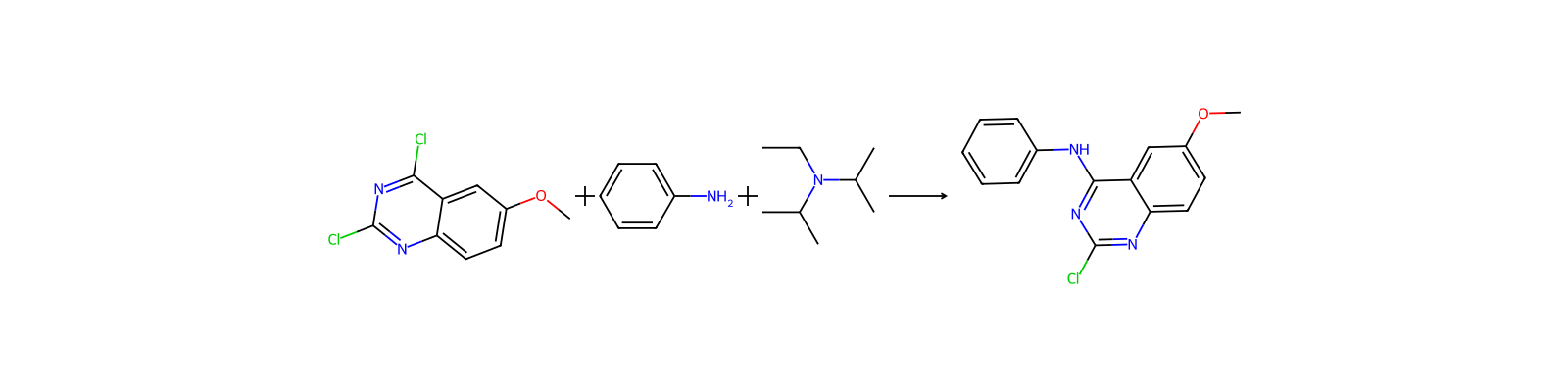
[Cl:1][C:2]1[N:11]=[C:10](Cl)[C:9]2[C:4](=[CH:5][CH:6]=[C:7]([O:13][CH3:14])[CH:8]=2)[N:3]=1.[NH2:15][C:16]1[CH:21]=[CH:20][CH:19]=[CH:18][CH:17]=1.C(N(CC)C(C)C)(C)C>>[Cl:1][C:2]1[N:11]=[C:10]([NH:15][C:16]2[CH:21]=[CH:20][CH:19]=[CH:18][CH:17]=2)[C:9]2[C:4](=[CH:5][CH:6]=[C:7]([O:13][CH3:14])[CH:8]=2)[N:3]=1Participants
4




Procedure
In a procedure analogous to that of Example 1a 2,4-dichloro-6-methoxy-quinazoline (1.53 g) (prepared as described in J. Chem. Soc. 1948, 1759), aniline (0.8 g) (0.184 g) and N,N-diisopropyl-ethylamine (1.72 g) are reacted together to give 2-chloro-6-methoxy-4-phenylamino-quinazoline as light yellow crystals melting at 177-179° C., Rf (A2) 0.59.
Sources & evidence
- ORD record
- ord-74ce11fc45374d519c9e174d9d4215a4
- Source dataset
- uspto-grants-2003_11
- Patent number
- US06645774B1
Reaction notes
Loading…