Tripropylamine → 4-Chloro-2-phenoxymethylquinazoline
Reaction equation
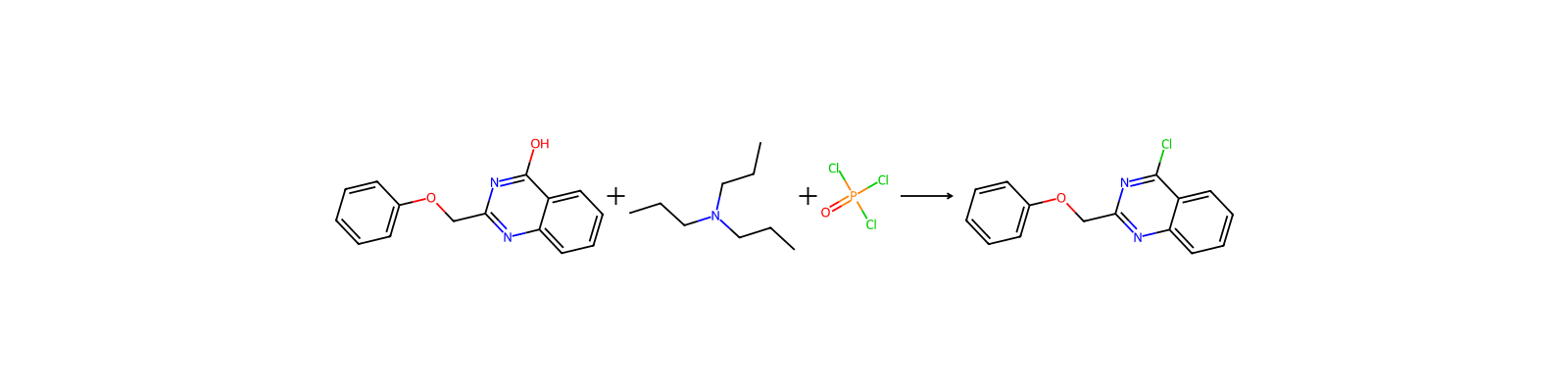
O[C:2]1[C:11]2[C:6](=[CH:7][CH:8]=[CH:9][CH:10]=2)[N:5]=[C:4]([CH2:12][O:13][C:14]2[CH:19]=[CH:18][CH:17]=[CH:16][CH:15]=2)[N:3]=1.C(N(CCC)CCC)CC.P(Cl)(Cl)([Cl:32])=O>>[Cl:32][C:2]1[C:11]2[C:6](=[CH:7][CH:8]=[CH:9][CH:10]=2)[N:5]=[C:4]([CH2:12][O:13][C:14]2[CH:19]=[CH:18][CH:17]=[CH:16][CH:15]=2)[N:3]=1Participants
4




Conditions
- Temperature
- 110 °C
Procedure
To a solution of 4-hydroxy-2-phenoxymethylquinazoline (2 g, 7.93 mmol) in phosphorus oxychloride (10 mL) is added tripropylamine (3.02 mL, 15.8 mmol) and the reaction mixture is heated for 30 minutes at 110° C. The excess phosphorus oxychloride is evaporated in vacuo, the residue is poured on ice cold aqueous NaHCO3 and extracted with ethyl acetate. The organic layer is washed with brine, dried, filtered and evaporated. The resulting residue is purified on flash chromatography (SiO2, hexane/AcOEt gradient) to give 4-chloro-2-phenoxymethylquinazoline.
Workup
- customThe excess phosphorus oxychloride is evaporated in vacuo
- additionthe residue is poured on ice cold aqueous NaHCO3
- extractionextracted with ethyl acetate
- washThe organic layer is washed with brine
- customdried
- filtrationfiltered
- customevaporated
- customThe resulting residue is purified on flash chromatography (SiO2, hexane/AcOEt gradient)
Sources & evidence
- ORD record
- ord-43a80436d4fc4b57aa1b9bcc392f708f
- Source dataset
- uspto-grants-2003_11
- Patent number
- US06653300B2
Reaction notes
Loading…