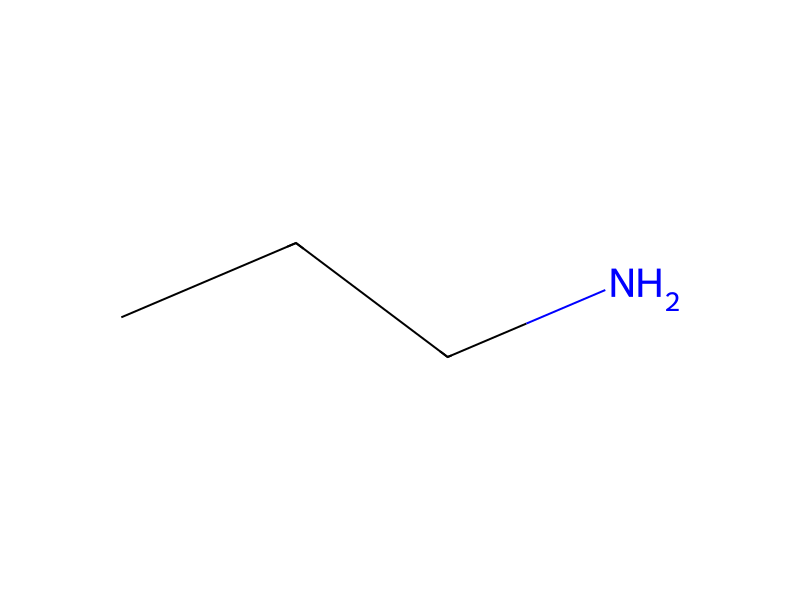
Propylamine → HCID 18980926, compound
Reaction equation

[NH2:1][CH2:2][CH2:3][CH3:4].[Cl:5][C:6]1[CH:11]=[CH:10][C:9]([C:12](=[O:15])[CH2:13]Br)=[CH:8][CH:7]=1.[OH-].[Na+].Cl[C:19]([O:21][CH2:22][C:23]([Cl:26])([Cl:25])[Cl:24])=[O:20]>C(Cl)Cl.O>[CH2:2]([N:1]([CH2:13][C:12]([C:9]1[CH:10]=[CH:11][C:6]([Cl:5])=[CH:7][CH:8]=1)=[O:15])[C:19]([O:21][CH2:22][C:23]([Cl:26])([Cl:25])[Cl:24])=[O:20])[CH2:3][CH3:4]Participants





Procedure
To 250 ml of methylene chloride was added 180 g (3050 mmole) of 1-aminopropane. The resulting mechanically stirred mixture was cooled to +5° C. (internal) and a solution of 117 g (500 mmole) 4'-chloro-2-bromoacetophenone in 250 ml of methylene chloride was added over 6 minutes while strictly maintaining the internal temperature between +5° C. and +15° C. as a moderate exotherm occurred. Toward the end of the addition, the internal temperature was allowed to rise to +20° C. After the addition was complete, the mixture was stirred at +20° C. for 9 minutes and then rapidly cooled to -5° C. whereon 40 g (500 mmole) of 50% aqueous sodium hydroxide dissolved in 300 ml of water was added. The mixture was transferred to a separatory funnel and the organic layer was separated and thrice washed with 500 ml portions of ice cold water. The organic layer was immediately recooled to -5° C. and a solution of 40 g (500 mmole) of 50% aqueous sodium hydroxide and a solution of 100 g (450 mmole) of 2,2,2-trichloroethyl chloroformate in 100 ml of methylene chloride were simultaneously added with rapid stirring while maintaining the internal temperature between -5° C. and +5° C. After stirring an additional 15 minutes, the organic layer was separated, washed with brine, dried over anhydrous magnesium sulfate, and concentrated in vacuo at 20 torr. The lower boiling impurities were then removed by distillation at 0.2 torr with the bath temperature rising to 200° C. and a head temperature of up to 130° C. The undistilled pot residue was dissolved in 300 ml of diethyl ether and 300 ml of hexane, filtered through silica gel and concentrated in vacuo to yield 120 g of the desired compound, an oil. An analytical sample was isolated by column chromatography on silica gel eluting with diethyl ether and hexanes.
Workup
- temperatureThe resulting mechanically stirred mixture was cooled to +5° C. (internal)
- temperaturewhile strictly maintaining the internal temperature between +5° C. and +15° C. as a moderate exotherm
- additionToward the end of the addition
- customto rise to +20° C
- additionAfter the addition
- additionwas added
- customThe mixture was transferred to a separatory funnel
- customthe organic layer was separated
- washthrice washed with 500 ml portions of ice cold water
- customwas immediately recooled to -5° C.
- stirringwith rapid stirring
- temperaturewhile maintaining the internal temperature between -5° C. and +5° C
- stirringAfter stirring an additional 15 minutes
- customthe organic layer was separated
- washwashed with brine
- dry with materialdried over anhydrous magnesium sulfate
- concentrationconcentrated in vacuo at 20 torr
- customThe lower boiling impurities were then removed by distillation at 0.2 torr with the bath temperature
- customrising to 200° C.
- customup to 130° C
- dissolutionThe undistilled pot residue was dissolved in 300 ml of diethyl ether
- filtration300 ml of hexane, filtered through silica gel
- concentrationconcentrated in vacuo
Sources & evidence
- ORD record
- ord-c3de28b29f814f848f87c6cbec8820d0
- Source dataset
- uspto-grants-1998_08
- Patent number
- US05798311
Reaction notes
Loading…