Isopropanol → HCID 54476761, compound
Reaction equation

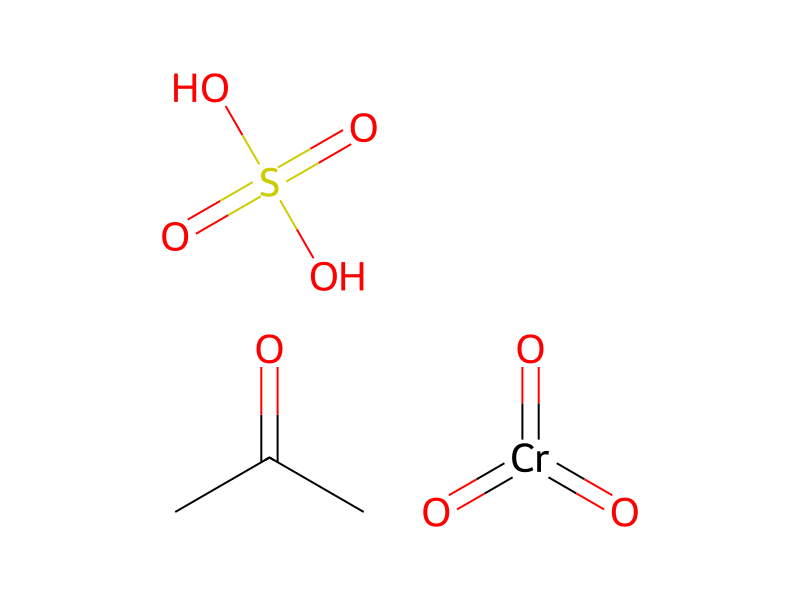
[F:1][C:2](=[CH:8][CH2:9][C:10]([F:23])=[CH:11][CH2:12][CH2:13][CH2:14][CH2:15][CH:16]=[CH:17][CH2:18][CH2:19][CH2:20][CH2:21][CH3:22])[CH2:3][CH2:4][CH2:5][CH:6]=[O:7].CC(C)=[O:26].OS(O)(=O)=O.O=[Cr](=O)=O.C(O)(C)C>CC(C)=O>[F:1][C:2](=[CH:8][CH2:9][C:10]([F:23])=[CH:11][CH2:12][CH2:13][CH2:14][CH2:15][CH:16]=[CH:17][CH2:18][CH2:19][CH2:20][CH2:21][CH3:22])[CH2:3][CH2:4][CH2:5][C:6]([OH:26])=[O:7]Participants
5
Reactant 3


Product 1

Reagents, catalysts & solvents 1

Conditions
- Temperature
- 0 °C
Procedure
To a solution of the aldehyde prepared in 1I (0.2 g, 0.61 mmoles) in acetone (7 ml) cooled to 0° C. was added dropwise 2.67M Jones reagent until the orange color was stable. The mixture was stirred 15 min. at 0° C. The excess of Jones reagent was reacted with isopropanol. The acetone was evaporated under reduced pressure without heating. The residue was taken with water and extracted three times with ethyl acetate. The organic layer was dried over sodium sulfate, filtered and concentrated under reduced pressure to leave an oil. Flash chromatography on silica gel and elution with a 25:75 mixture of ethyl acetate and hexane afforded the expected acid as an oil (0.125 g, 60%).
Workup
- customThe acetone was evaporated under reduced pressure
- temperaturewithout heating
- extractionextracted three times with ethyl acetate
- dry with materialThe organic layer was dried over sodium sulfate
- filtrationfiltered
- concentrationconcentrated under reduced pressure
- customto leave an oil
- washFlash chromatography on silica gel and elution
- additionwith a 25:75 mixture of ethyl acetate and hexane
Sources & evidence
- ORD record
- ord-4f5066156bf74dfeb12e03bac951001d
- Source dataset
- uspto-grants-1993_07
- Patent number
- US05225429
Reaction notes
Loading…