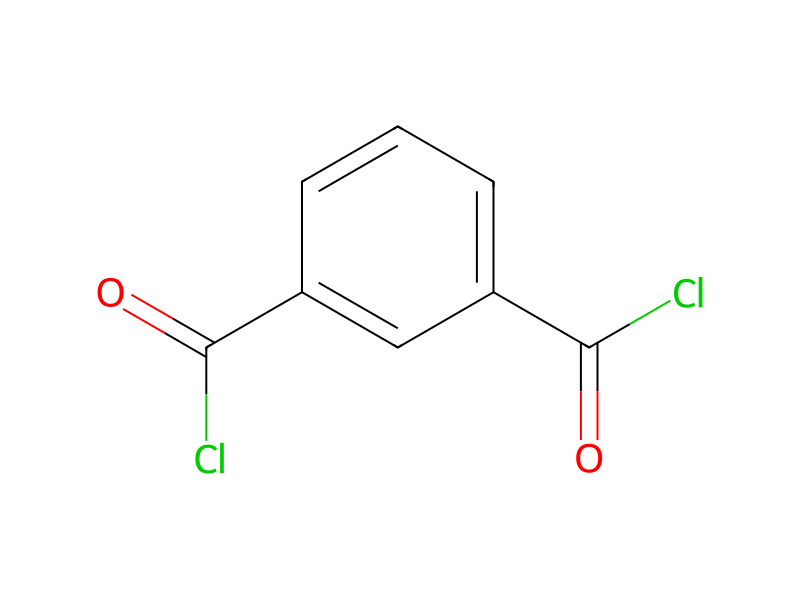
Isophthaloyl chloride → (1,1'-Biphenyl)-2,3'-diol
Reaction equation

OC1C=CC([C:8]([C:16]2[CH:21]=[CH:20][C:19]([OH:22])=[CH:18]C=2)([C:10]2[CH:15]=[CH:14][CH:13]=[CH:12][CH:11]=2)C)=CC=1.C(Cl)(=O)C1C=CC=C(C(Cl)=[O:28])C=1>>[CH:12]1[CH:11]=[C:10]([C:8]2[CH:16]=[CH:21][CH:20]=[C:19]([OH:22])[CH:18]=2)[C:15]([OH:28])=[CH:14][CH:13]=1Participants
3


Procedure
A polyester of 1,1-bis-(4-hydroxy-phenyl)-1-phenyl-ethane (diphenol B) and an equimolar mixture of isophthaloyl chloride and terephthaloychloride were reacted in a two-phase boundary surface to form a diphenol B polyester with an η inh.=0.76 dl/g. 1.9 kg of the said polyester were dissolved in 8.1 mg of 1,2-dichloroethane to obtain 10 kg of a spinning solution with a FB viscosity of 63 s/400 mm. The spinning procedure of Example 1 was repeated with the spinning solution to obtain individual fibers with the following properties: titer of 2.5 den; elasticity modulus of 1.41×10⁶N/cm2 ; tensile strength of 1.03×10⁴N/cm2 (0.97 g/den); and tear elongation of 7.8%.
Workup
- customwere reacted in a two-phase boundary surface
Sources & evidence
- ORD record
- ord-7acdfadf79434e4ba282de41e3a72ee9
- Source dataset
- uspto-grants-1985_08
- Patent number
- US04533511
Reaction notes
Loading…