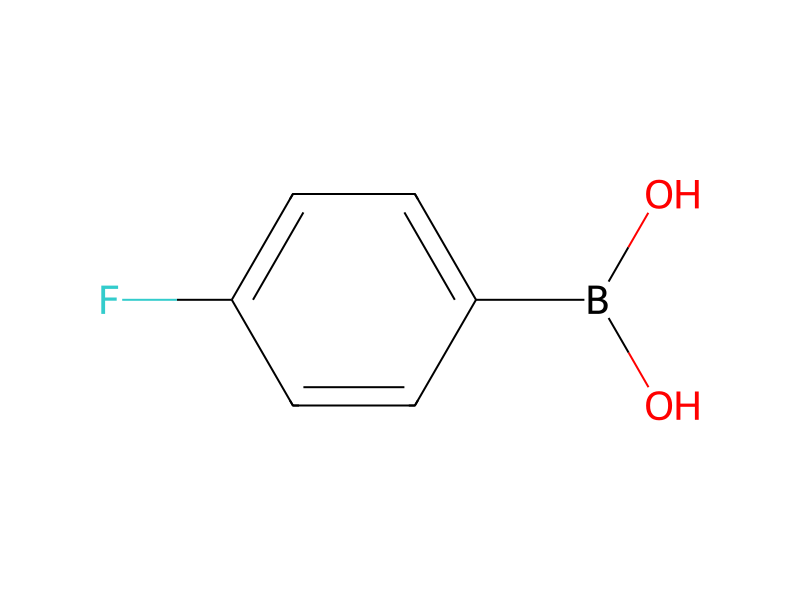
4-Fluorophenylboronic acid → [5-(4-Fluorophenyl)pyridin-3-yl]methanol
Reaction equation

[F:1][C:2]1[CH:7]=[CH:6][C:5](B(O)O)=[CH:4][CH:3]=1.C(=O)([O-])O.[Na+].Br[C:17]1[CH:18]=[C:19]([CH2:23][OH:24])[CH:20]=[N:21][CH:22]=1>C1C=CC([P]([Pd]([P](C2C=CC=CC=2)(C2C=CC=CC=2)C2C=CC=CC=2)([P](C2C=CC=CC=2)(C2C=CC=CC=2)C2C=CC=CC=2)[P](C2C=CC=CC=2)(C2C=CC=CC=2)C2C=CC=CC=2)(C2C=CC=CC=2)C2C=CC=CC=2)=CC=1.C1(C)C=CC=CC=1.O>[F:1][C:2]1[CH:7]=[CH:6][C:5]([C:17]2[CH:22]=[N:21][CH:20]=[C:19]([CH:18]=2)[CH2:23][OH:24])=[CH:4][CH:3]=1Participants
7
Reactant 3


Product 1

Reagents, catalysts & solvents 3



Procedure
13.2 g of 4-fluorobenzeneboronic acid and 10.8 g of sodium hydrogen-carbonate are initially introduced, and a mixture of 16.1 g of 5-bromo-3-hydroxymethylpyridine, 30 ml of water and 60 ml of toluene is added with stirring and under a protective gas. A further 14 ml of water, 28 ml of toluene and 0.5 g of tetrakis(triphenylphosphine)palladium(0) are subsequently added. The reaction mixture is heated to reflux and held at this temperature for 2 hours. After cooling, the mixture is subjected to conventional work-up, giving 5-(4-fluorophenyl)nicotinyl alcohol. The alcohol is subsequently oxidized by conventional methods to give 5-(4-fluorophenyl)nicotinic acid.
Workup
- additionis added
- temperatureThe reaction mixture is heated
- temperatureto reflux
- temperatureAfter cooling
Sources & evidence
- ORD record
- ord-978e7607057a4582b3aeadc747bd11da
- Source dataset
- uspto-grants-2004_03
- Patent number
- US06703509B2
Reaction notes
Loading…