1-Adamantanecarbonyl chloride → HCID 22402381, compound
Reaction equation
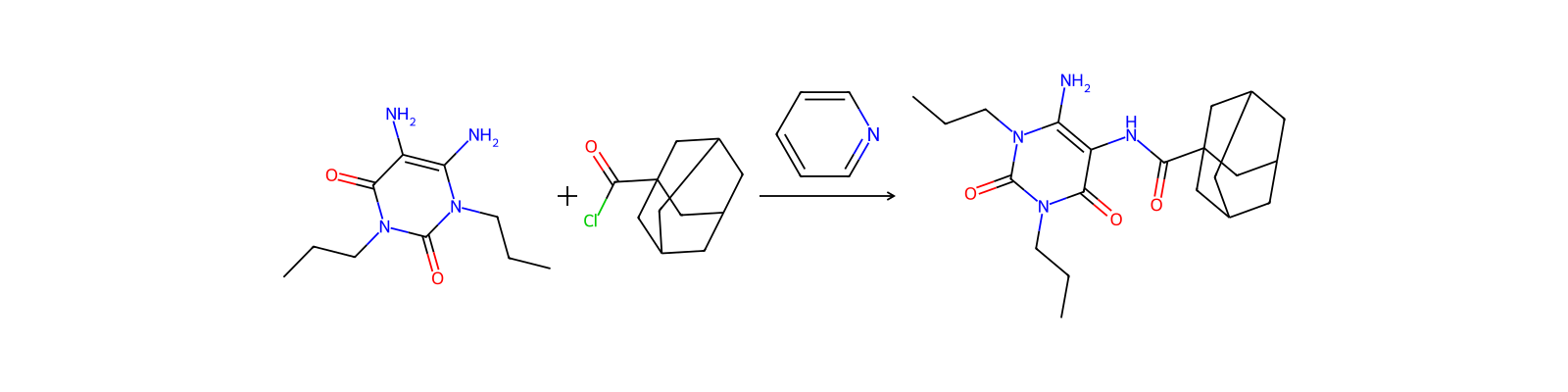
[CH2:1]([N:4]1[C:11]([NH2:12])=[C:10]([NH2:13])[C:8](=[O:9])[N:7]([CH2:14][CH2:15][CH3:16])[C:5]1=[O:6])[CH2:2][CH3:3].[C:17]12([C:27](Cl)=[O:28])[CH2:26][CH:21]3[CH2:22][CH:23]([CH2:25][CH:19]([CH2:20]3)[CH2:18]1)[CH2:24]2>N1C=CC=CC=1>[NH2:12][C:11]1[N:4]([CH2:1][CH2:2][CH3:3])[C:5](=[O:6])[N:7]([CH2:14][CH2:15][CH3:16])[C:8](=[O:9])[C:10]=1[NH:13][C:27]([C:17]12[CH2:26][CH:21]3[CH2:20][CH:19]([CH2:25][CH:23]([CH2:22]3)[CH2:24]1)[CH2:18]2)=[O:28]Participants
Reactant 2


Product 1

Reagents, catalysts & solvents 1

Conditions
- Temperature
- 0 °C
Procedure
At first, 10 g (44.3 mmol) of 1,3-dipropyl-5,6-diaminouracil was dissolved in 50 ml of pyridine, and 10.6 g (53.1 mmol) of adamantane-1-carbonylchloride was added by portions thereto at 0° C. After stirring for 30 minutes at 0° C., the mixture was concentrated under reduced pressure. A saturated aqueous sodium bicarbonate was added thereto. The residue was extracted with chloroform three times. The organic layers were combined, washed with a saturated aqueous sodium chloride, and dried over anhydrous sodium sulfate. The solvent was evaporated under reduced pressure. Then pyridine was removed from the residue by means of azeotropy with toluene to afford 19.5 g (yield: 100%) of 6-amino-5-(adamantane-1-carbonylamino)-1,3-dipropyluracil.
Workup
- customat 0° C
- concentrationthe mixture was concentrated under reduced pressure
- additionA saturated aqueous sodium bicarbonate was added
- extractionThe residue was extracted with chloroform three times
- washwashed with a saturated aqueous sodium chloride
- dry with materialdried over anhydrous sodium sulfate
- customThe solvent was evaporated under reduced pressure
- customThen pyridine was removed from the residue by means of azeotropy with toluene
Sources & evidence
- ORD record
- ord-7efc199e841a476485545fe9106cd0e2
- Source dataset
- uspto-grants-1994_03
- Patent number
- US05290782
Reaction notes
Loading…