Isonicotinoyl chloride hydrochloride → 1-cyclopentyl-3-phenylmethyl-4-cyano-5-(4-pyridinecarboxamido)-1H-pyrazole
Reaction equation

Cl.[N:2]1[CH:7]=[CH:6][C:5]([C:8](Cl)=[O:9])=[CH:4][CH:3]=1.[CH:11]1([N:16]2[C:20]([NH2:21])=[C:19]([C:22]#[N:23])[C:18]([CH2:24][C:25]3[CH:30]=[CH:29][CH:28]=[CH:27][CH:26]=3)=[N:17]2)[CH2:15][CH2:14][CH2:13][CH2:12]1>>[CH:11]1([N:16]2[C:20]([NH:21][C:8]([C:5]3[CH:6]=[CH:7][N:2]=[CH:3][CH:4]=3)=[O:9])=[C:19]([C:22]#[N:23])[C:18]([CH2:24][C:25]3[CH:26]=[CH:27][CH:28]=[CH:29][CH:30]=3)=[N:17]2)[CH2:12][CH2:13][CH2:14][CH2:15]1Participants
3
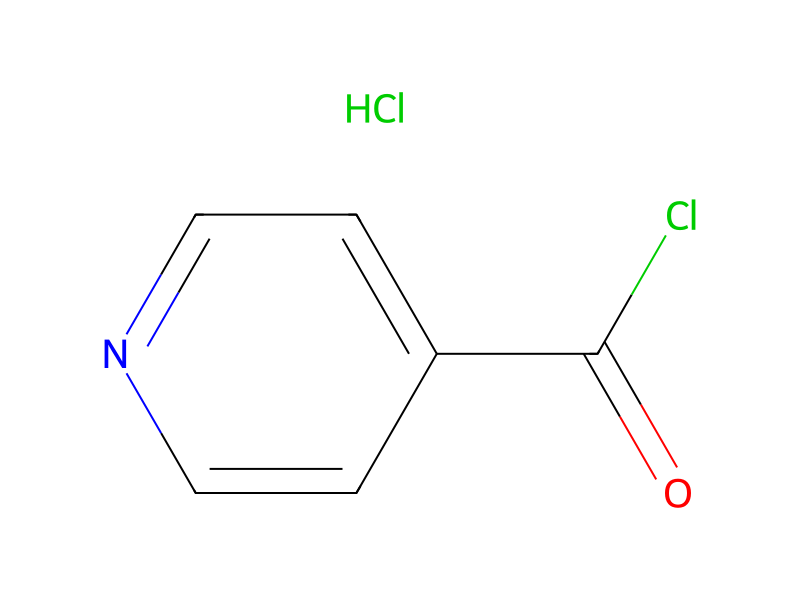


Conditions
- Temperature
- 200 °C
Procedure
4-Pyridinecarboxylic acid chloride hydrochloride (4.3 g, 24 mmol), and 1-cyclopentyl-3-phenylmethyl-4-cyano-5-amino-1H-pyrazole (3.2 g, 12.0 mmol) were combined and heated to 200° C. under argon for 5 minutes. The reaction mixture was cooled to room temperature and the residue was partitioned between chloroform and sat. NaHCO3. The organic layer was separated, washed with additional sat. NaHCO3, dried over anhydrous MgSO4 passed through a plug of silica and the solvent was removed in vacuo to afford 3.8 g (84%) of 1-cyclopentyl-3-phenylmethyl-4-cyano-5-(4-pyridinecarboxamido)-1H-pyrazole as white crystals, m.p. 189°-191° C. when recrystallized from ethyl acetate and dried at 80° C. for 8 hours in high vacuum.
Workup
- temperatureThe reaction mixture was cooled to room temperature
- customthe residue was partitioned between chloroform and sat. NaHCO3
- customThe organic layer was separated
- washwashed with additional sat. NaHCO3
- dry with materialdried over anhydrous MgSO4
- customthe solvent was removed in vacuo
Sources & evidence
- ORD record
- ord-31f29cbe52c7475c8a5607b69c73079b
- Source dataset
- uspto-grants-1994_03
- Patent number
- US05294612
Reaction notes
Loading…