Dicyclohexylcarbodiimide → N,N'-Dicyclohexylurea
Reaction equation

[OH:1]N1C(=O)CCC1=O.[CH2:9]1[CH2:14][CH2:13][CH:12]([N:15]=[C:16]=[N:17][CH:18]2[CH2:23][CH2:22][CH2:21][CH2:20][CH2:19]2)[CH2:11][CH2:10]1>C(OCC)(=O)C>[CH:18]1([NH:17][C:16]([NH:15][CH:12]2[CH2:11][CH2:10][CH2:9][CH2:14][CH2:13]2)=[O:1])[CH2:23][CH2:22][CH2:21][CH2:20][CH2:19]1Participants
Reactant 2


Product 1
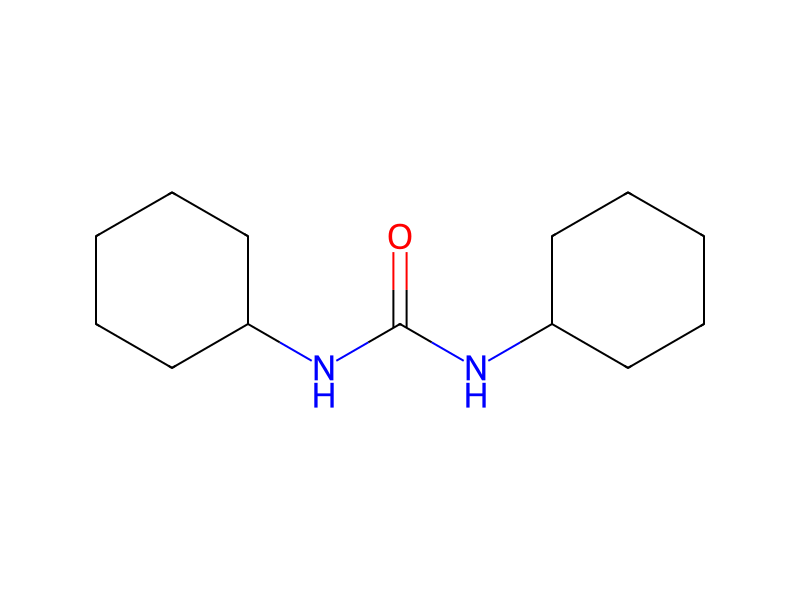
Reagents, catalysts & solvents 1

Procedure
The copolymer was fed into a round-bottomed flask and dissolved in a half amount (25 to 30 mL) of ethyl acetate. Next, N-hydroxysuccinimide and DCC were added thereto followed by dissolution in the residual ethylacetate. The obtained mixture was immersed in ice-water at 4° C. and stirred with a stirrer for 2 hours. Subsequently, it was introduced into a thermostat at 25° C. and stirred therein overnight. The solution was filtered and thus dicyclohexyl urea formed as a by product was removed therefrom. After concentrating under reduced pressure, the residue was purified with diethyl ether. The product thus obtained was taken up by filtration and dried under reduced pressure. The succinylated copolymer thus obtained was stored in a freezer.
Workup
- customThe copolymer was fed into a round-bottomed flask
- additionSubsequently, it was introduced into a thermostat at 25° C.
- stirringstirred
- customovernight
- filtrationThe solution was filtered
Sources & evidence
- ORD record
- ord-04f9ce3b4a994751845b4f99bd59f232
- Source dataset
- uspto-grants-2004_03
- Patent number
- US06706187B1
Reaction notes
Loading…