Pyridine → 3-Bromo-5-(bromomethyl)pyridine
Reaction equation

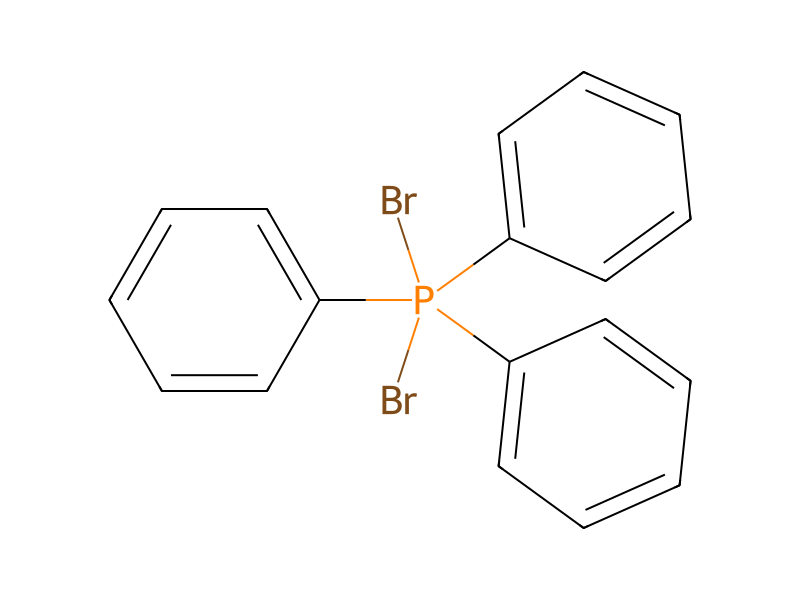
[Br:1][C:2]1[CH:3]=[N:4][CH:5]=[C:6]([CH2:8]O)[CH:7]=1.N1C=CC=CC=1.[Br:16]P(Br)(C1C=CC=CC=1)(C1C=CC=CC=1)C1C=CC=CC=1>C(#N)C>[Br:1][C:2]1[CH:3]=[N:4][CH:5]=[C:6]([CH2:8][Br:16])[CH:7]=1Participants
Reactant 3


Product 1

Reagents, catalysts & solvents 1

Conditions
- Temperature
- 0 °C
Procedure
3-Bromo-5-hydroxymethylpyridine (16.1 mmol) [prepared according to the procedure of Ashimori et al, Chem. Pharm. Bull. 1990, 38(9), 2446] and pyridine (32.3 mmol) were dissolved in acetonitrile (32 mL) and cooled to 0° C. Dibromotriphenylphosphorane (20.9 mmol) added, and left reaction mixture to warm to room temperature in stoppered flask for 4 hours. The crude reaction mixture was purified by column chromatography directly on silica gel with diethyl ether:cyclohexane=1:1. 3-Bromo-5-bromomethylpyridine was isolated as a pale brown solid. 3-Bromo-5-bromomethylpyridine (7.7 mmol) and di-tert-butyliminodicarboxylate (10 mmol) were dissolved in tetrahydrofaran (20 mL), and sodium hydride (60% in mineral oil, 10 mmol) added at room temperature under argon. The reaction mixture was stirred at room temperature for 16 hours, quenched with saturated aqueous ammonium chloride, extracted into ethyl acetate, washed with brine, dried over magnesium sulfate, and concentrated to dryness. The crude residue was purified by column chromatography on silica gel with cyclohexane:diethyl ether=2:1. 3-bromo-5-(N,N-bis-tert-butoxycarbonyl)aminomethylpyridine was isolated as a pale yellow solid. MS (EI) 387 and 389 (M++H).
Workup
- waitleft
- customreaction mixture
- temperatureto warm to room temperature in stoppered flask for 4 hours
- customThe crude reaction mixture
- customwas purified by column chromatography directly on silica gel with diethyl ether
Sources & evidence
- ORD record
- ord-1492e38db49047218c438f6d0d5d58bb
- Source dataset
- uspto-grants-2005_12
- Patent number
- US06977263B2
Reaction notes
Loading…