Acetic Acid → HCID 57675754, compound
Reaction equation

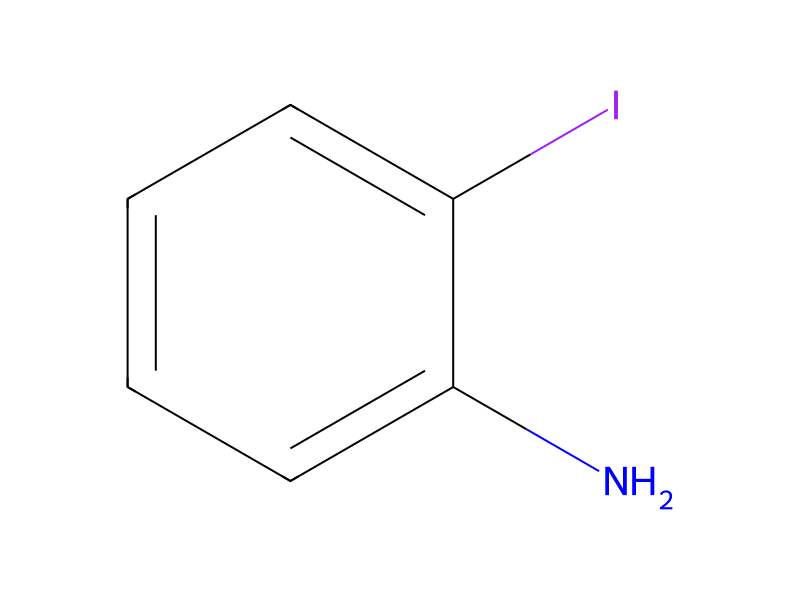
[I:1][C:2]1[CH:8]=[CH:7][CH:6]=[CH:5][C:3]=1[NH2:4].[Si:9]([O:16][CH:17]1[CH2:22][CH2:21][C:20](=O)[CH2:19][CH2:18]1)([C:12]([CH3:15])([CH3:14])[CH3:13])([CH3:11])[CH3:10].C(O)(=O)C.C(O[BH-](OC(=O)C)OC(=O)C)(=O)C.[Na+]>ClCCl>[Si:9]([O:16][CH:17]1[CH2:18][CH2:19][CH:20]([NH:4][C:3]2[CH:5]=[CH:6][CH:7]=[CH:8][C:2]=2[I:1])[CH2:21][CH2:22]1)([C:12]([CH3:15])([CH3:14])[CH3:13])([CH3:11])[CH3:10]Participants
6





Procedure
To a solution of 2-iodoaniline (2.5 g, 10.9 mmol) in dichloromethane (160 mL) was added 4-(tert-butyldimethylsilanyloxy)cyclohexanone (2.39 g, 10.9 mmol) and acetic acid (8 mL). After the reaction was stirred for 1 hour at room temperature, sodium triacetoxyborohydride (3.47 g, 16.4 mmol) was added and the reaction was stirred at room temperature overnight. The reaction was quenched with saturated sodium bicarbonate and extracted with dichloromethane. The organic solution was dried (MgSO4) and concentrated to give 4.47 g of the desired amine, which was used without further purification. LC-MS (C18H30INOSi calc'd 431) m/z 432 (M+H).
Workup
- stirringthe reaction was stirred at room temperature overnight
- customThe reaction was quenched with saturated sodium bicarbonate
- extractionextracted with dichloromethane
- dry with materialThe organic solution was dried (MgSO4)
- concentrationconcentrated
Sources & evidence
- ORD record
- ord-99507890bb8a47918d871f6898200911
- Source dataset
- uspto-grants-2009_05
- Patent number
- US07528262B2
Reaction notes
Loading…