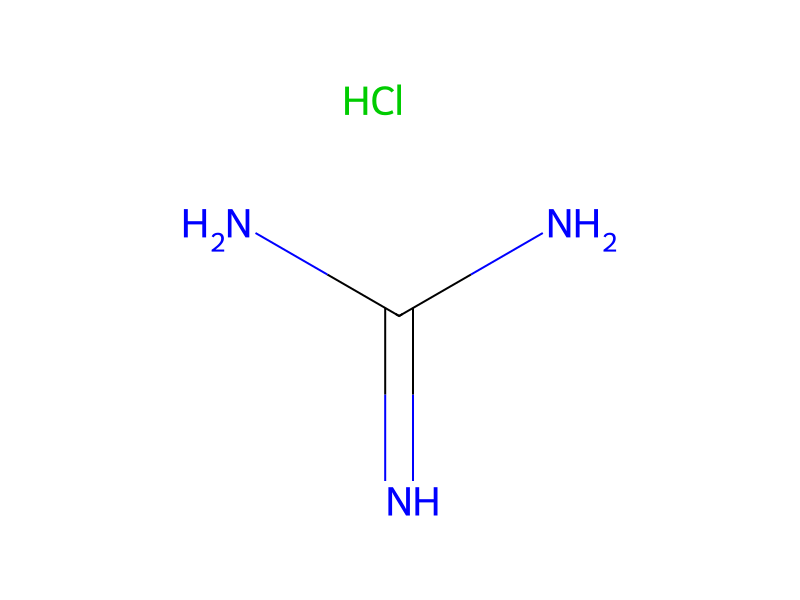
Guanidine Hydrochloride → HCID 57678441, compound
Reaction equation

[I:1][C:2]1[CH:13]=[C:12]([O:14][CH3:15])[C:11]([I:16])=[CH:10][C:3]=1[O:4][C:5](=[CH:8]C)[C:6]#[N:7].Cl.NC1C=CC=CC=1.O(C)[Na].Cl.[NH2:29][C:30]([NH2:32])=[NH:31]>C(O)C.CO>[I:1][C:2]1[CH:13]=[C:12]([O:14][CH3:15])[C:11]([I:16])=[CH:10][C:3]=1[O:4][C:5]1[C:6]([NH2:7])=[N:29][C:30]([NH2:32])=[N:31][CH:8]=1Participants




Conditions
- Temperature
- 85 °C
Procedure
2-(2,5-Diiodo-4-methoxy-phenoxy)-but-2-enenitrile (3.47 g, 6.75 mmol) and aniline hydrochloride (3.5 g, 27 mmol) were dissolved in 27 mL ethanol. The reaction mixture was heated to 85° C. and stirred under nitrogen for 18 hours. The reaction mixture was cooled and 25% NaOCH3 in methanol (7.3 mL) was added, followed by guanidine hydrochloride (3.2 g), and ethanol (10 mL). The reaction mixture was heated to 100° C. for 21 hours, then cooled and concentrated under reduced pressure. The residue was poured into water and extracted with dichloromethane. The combined organic layers were dried over Na2SO4, filtered and concentrated under reduced pressure to give 1.2 g of 5-(2,5-Diiodo-4-methoxy-phenoxy)-pyrimidine-2,4-diamine, MS (M+H)=485.
Workup
- temperatureThe reaction mixture was cooled
- temperatureThe reaction mixture was heated to 100° C. for 21 hours
- temperaturecooled
- concentrationconcentrated under reduced pressure
- additionThe residue was poured into water
- extractionextracted with dichloromethane
- dry with materialThe combined organic layers were dried over Na2SO4
- filtrationfiltered
- concentrationconcentrated under reduced pressure
Sources & evidence
- ORD record
- ord-c8a6a9147aa74e76860095c949d126ca
- Source dataset
- uspto-grants-2009_05
- Patent number
- US07531547B2
Reaction notes
Loading…