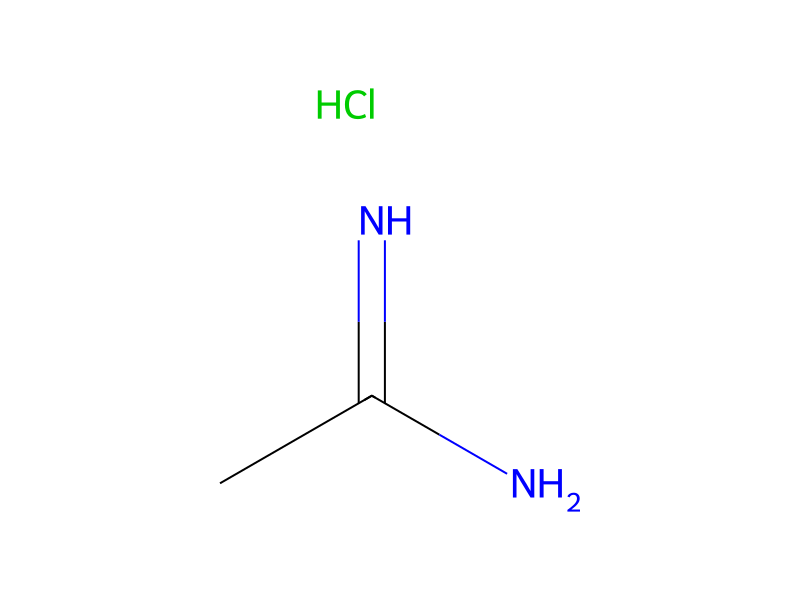
Acetamidine monohydrochloride → HCID 178432569, compound
Reaction equation

Cl.[C:2]([NH2:5])(=[NH:4])[CH3:3].[CH2:6]([O:13][C:14](=[O:29])[NH:15][CH2:16][CH2:17][O:18][C:19]1[CH:24]=[CH:23][C:22]([C:25](=O)[CH2:26]Br)=[CH:21][CH:20]=1)[C:7]1[CH:12]=[CH:11][CH:10]=[CH:9][CH:8]=1.[O-]CC.[Na+]>C(O)C>[CH2:6]([O:13][C:14](=[O:29])[NH:15][CH2:16][CH2:17][O:18][C:19]1[CH:20]=[CH:21][C:22]([C:25]2[N:4]=[C:2]([CH3:3])[NH:5][CH:26]=2)=[CH:23][CH:24]=1)[C:7]1[CH:12]=[CH:11][CH:10]=[CH:9][CH:8]=1Participants
5
Reactant 3


Product 1

Reagents, catalysts & solvents 1

Conditions
- Temperature
- 80 °C
Procedure
Acetamidine hydrochloride (112 mg, 1.18 mmol), benzyl-[2-(4-bromoacetyl-phenoxy)-ethyl]-carbamate (160 mg, 0.39 mmol), and sodium ethoxide (80.3 mg, 1.18 mmol) were combined in a round-bottomed flask, dissolved in ethanol, and heated to about 80° C. for about two hours. The reaction mixture was then allowed to cool to room temperature, and the resulting heterogenous mixture was filtered. The filtrate was then concentrated in vacuo to an oil which was purified by column chromatography (silica gel; 5% methanol/methylene chloride to 10% methanol/methylene chloride) to afford 92 mg (64% yield) of the desired product. LRMS ([M+H]+)=352.2.
Workup
- temperatureto cool to room temperature
- filtrationthe resulting heterogenous mixture was filtered
- concentrationThe filtrate was then concentrated in vacuo to an oil which
- customwas purified by column chromatography (silica gel; 5% methanol/methylene chloride to 10% methanol/methylene chloride)
Sources & evidence
- ORD record
- ord-fe29b5ff1a114e16a240a8f32959a868
- Source dataset
- uspto-grants-2004_03
- Patent number
- US06706743B2
Reaction notes
Loading…