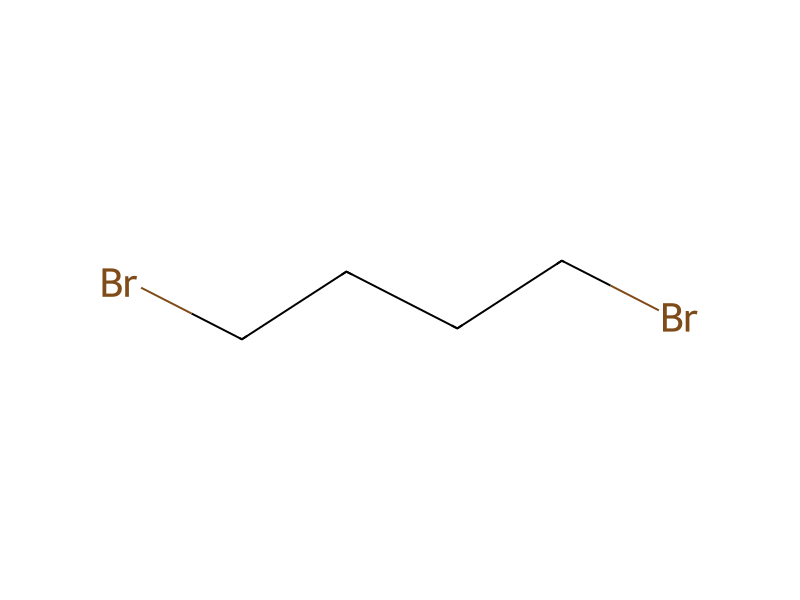
1,4-Dibromobutane → 5-(4-Bromo-butoxy)-2,3-dihydro-indole-1-carboxylic acid 4-chloro-phenyl ester
Reaction equation

[Cl:1][C:2]1[CH:7]=[CH:6][C:5]([O:8][C:9]([N:11]2[C:19]3[C:14](=[CH:15][C:16]([OH:20])=[CH:17][CH:18]=3)[CH2:13][CH2:12]2)=[O:10])=[CH:4][CH:3]=1.C([O-])([O-])=O.[K+].[K+].[Br:27][CH2:28][CH2:29][CH2:30][CH2:31]Br>CC(C)=O.CCOCC.O>[Cl:1][C:2]1[CH:7]=[CH:6][C:5]([O:8][C:9]([N:11]2[C:19]3[C:14](=[CH:15][C:16]([O:20][CH2:31][CH2:30][CH2:29][CH2:28][Br:27])=[CH:17][CH:18]=3)[CH2:13][CH2:12]2)=[O:10])=[CH:4][CH:3]=1Participants
7
Reactant 3


Product 1

Reagents, catalysts & solvents 3



Conditions
- Temperature
- 50 °C
Procedure
290 mg (1 mmol) 5-Hydroxy-2,3-dihydro-indole-1-carboxylic acid 4-chloro-phenyl ester in 5 ml acetone were treated with 320 mg (3 mmol) K2CO3 (powdered) and 0.23 ml (2 mmol) 1,4-dibromobutane. The suspension was stirred at 50° C. for 4 h, cooled to RT, and was diluted with ether and water. The aqueous phase was extracted with ether, the organic phases were washed with water and dried over Na2SO4. Column chromatography on silica gel with hexane/EtOAc 9:1 yielded 210 mg (49%) 5-(4-Bromo-butoxy)-2,3-dihydro-indole-1-carboxylic acid 4-chloro-phenyl ester as colorless solid, MS: 423 (M, 1Br, 1Cl).
Workup
- temperaturecooled to RT
- extractionThe aqueous phase was extracted with ether
- washthe organic phases were washed with water
- dry with materialdried over Na2SO4
Sources & evidence
- ORD record
- ord-a02a88f0a9fe4a9c8b454315f934328f
- Source dataset
- uspto-grants-2004_03
- Patent number
- US06706751B2
Reaction notes
Loading…