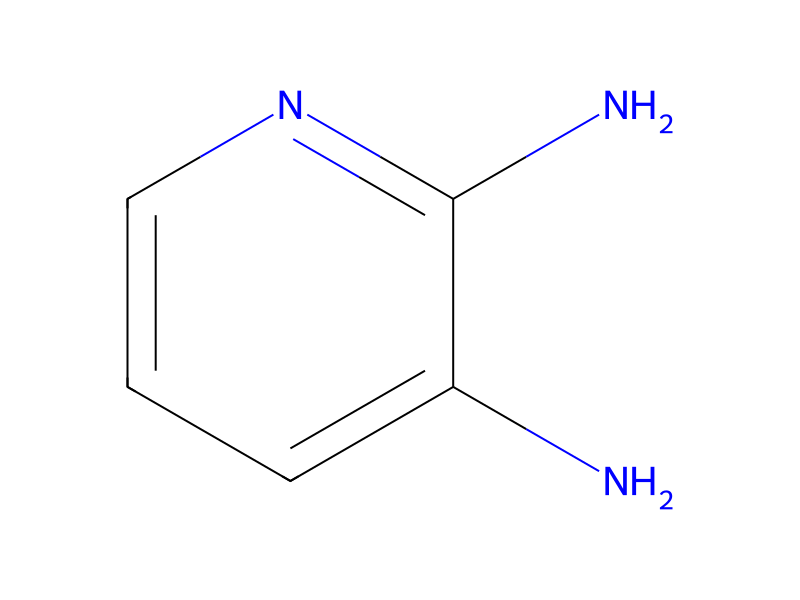
2,3-Diaminopyridine → HCID 178488850, compound
Reaction equation

[NH2:1][C:2]1[C:7]([NH2:8])=[CH:6][CH:5]=[CH:4][N:3]=1.[CH3:9][O:10][C:11]1[CH:19]=[CH:18][C:14]([C:15](O)=O)=[CH:13][C:12]=1[N+:20]([O-:22])=[O:21]>P(Cl)(Cl)(Cl)=O>[N:8]1[C:7]2[C:2](=[N:3][CH:4]=[CH:5][CH:6]=2)[NH:1][C:15]=1[C:14]1[CH:18]=[CH:19][C:11]([O:10][CH3:9])=[C:12]([N+:20]([O-:22])=[O:21])[CH:13]=1Participants
Reactant 2

Product 1

Reagents, catalysts & solvents 1

Procedure
2,3-Diaminopyridine (10 g, 91.6 mmol) and 18.07 g of 4-methoxy-3-nitro benzoic acid were mixed together, and the mixture was added in portions to 200 mL of phosphorous oxychloride at. room temperature. The resulting mixture was heated to reflux for 4 hours, and then cooled to room temperature and allowed to stir overnight. The reaction was rotary evaporated in vacuo, and the residue was carefully quenched with saturated sodium bicarbonate solution, filtered, and dried on the vacuum filter overnight to give a brown solid. The solid was washed with several fractions of ethyl acetate to yield 21.36 g of 5-(3H-imidazo[4,5-b]pyridin-2-yl)-2-methoxy-nitrobenzene as a dark brown solid that was used without further purification. 1H-NMR (DMSO-d6); δ 8.71 (d, 1H), 8.48 (dd, 1H), 8.31 (dd, 1H), 7.99 (d, 1H), 7.58 (d, 1H), 7.23 (dd, 1H), 4.00 (s, 3H) ppm.
Workup
- customroom temperature
- temperatureThe resulting mixture was heated
- temperatureto reflux for 4 hours
- customThe reaction was rotary evaporated in vacuo
- customthe residue was carefully quenched with saturated sodium bicarbonate solution
- filtrationfiltered
- customdried on the vacuum
- filtrationfilter overnight
- customto give a brown solid
- washThe solid was washed with several fractions of ethyl acetate
Sources & evidence
- ORD record
- ord-04fae98f41924ed7992ebf6f559f6c6d
- Source dataset
- uspto-grants-2005_09
- Patent number
- US06943174B2
Reaction notes
Loading…