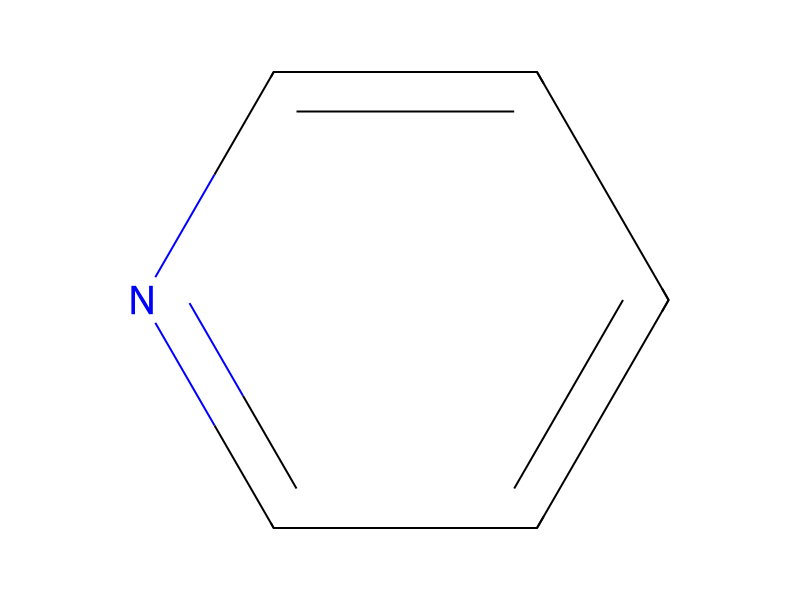
Pyridine → 2-Amino-6-chloropurine
Reaction equation

F[C:2]1[N:10]=[C:9]2[C:5]([NH:6][CH:7]=[N:8]2)=[C:4]([Cl:11])[N:3]=1.C1C=C(Cl)C=C(C(OO)=O)C=1.[N:23]1C=CC=CC=1>>[NH2:23][C:2]1[N:10]=[C:9]2[C:5]([NH:6][CH:7]=[N:8]2)=[C:4]([Cl:11])[N:3]=1Participants


Procedure
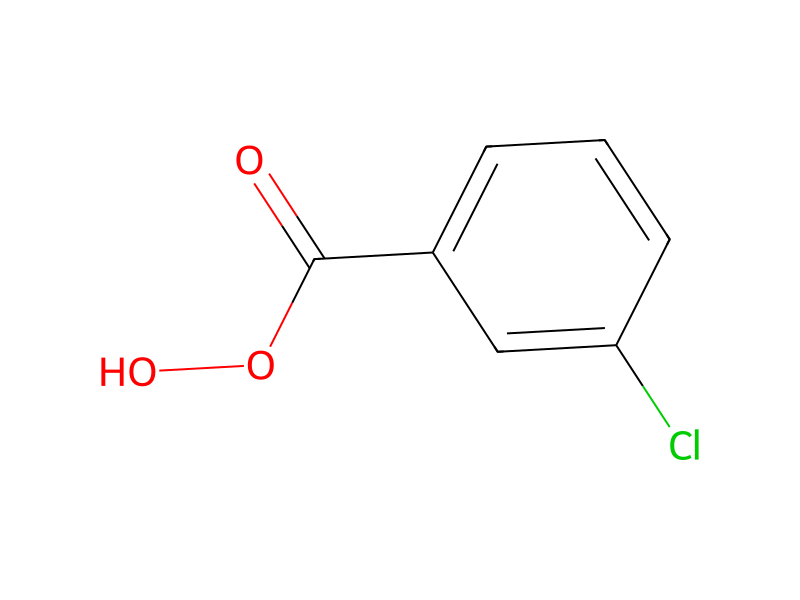
The synthesis of purine analogues needed more careful treatments. The key intermediate D-8 was condensed with 6-chloropurine and 2-fluoro-6-chloropurine to give the corresponding nucleosides D-21 and D-22 in 65% and 66% yield, respectively. To achieve a clean and high-yield conversion, the temperature of the reaction mixture had to be carefully controlled in such a manner that, after addition of TMSOTf at 0° C., the reaction mixture was stirred for 6 hours at room temperature and then for 2 hours at 60° C. The 6-chloropurine derivative D-21 was syn-eliminated by successive treatment with mCPBA and pyridine to give an inseparable mixture of 2′,3′-unsaturated nucleoside D-23 and its Δ1,2-isomer D-24 in 81% yield (3:1 determined by 1H NMR). Amination of the mixture of D-23 and D-24 by treatment with methanolic ammonia at 100° C. in a steel bomb gave the adenosine analogue, which was deprotected by TBAF in THF to give 2′-fluoro4′-thio-2′,3′-unsaturated adenosine 24 in 61% yield. The Δ1,2-isomer D-24, however, did not survive under reaction conditions and silica gel column chromatography due to its instability. The 2-fluoro-6-chloropurine derivative D-22 was also treated with mCPBA followed by pyridine to give an inseparable mixture of the syn-eliminated product D-25 and its Δ1,2-isomer D-26 in 71% yield. Dry ammonia gas was bubbled into a solution of D-25 and D-26 in ethylene glycol dimethyl ether (DME) at room temperature for 16 hours to give the 2-amino-6-chloropurine derivative D-29 and 2-fluoro-6-aminopurine derivative D-30 in 45% and 25% yield, respectively, which were readily separated by silica gel column chromatography. The Δ1,2-isomer D-26 was not stable enough to survive the reaction and purification conditions.
Workup
- customThe Δ1,2-isomer D-24, however, did not survive under reaction conditions and silica gel column chromatography due to its instability
- customto give
- additionan inseparable mixture of the syn-eliminated product
- customDry ammonia gas was bubbled into a solution of D-25 and D-26 in ethylene glycol dimethyl ether (DME) at room temperature for 16 hours
Sources & evidence
- ORD record
- ord-ee494260839147b184bd4349c48c6631
- Source dataset
- uspto-grants-2005_09
- Patent number
- US06949522B2
Reaction notes
Loading…