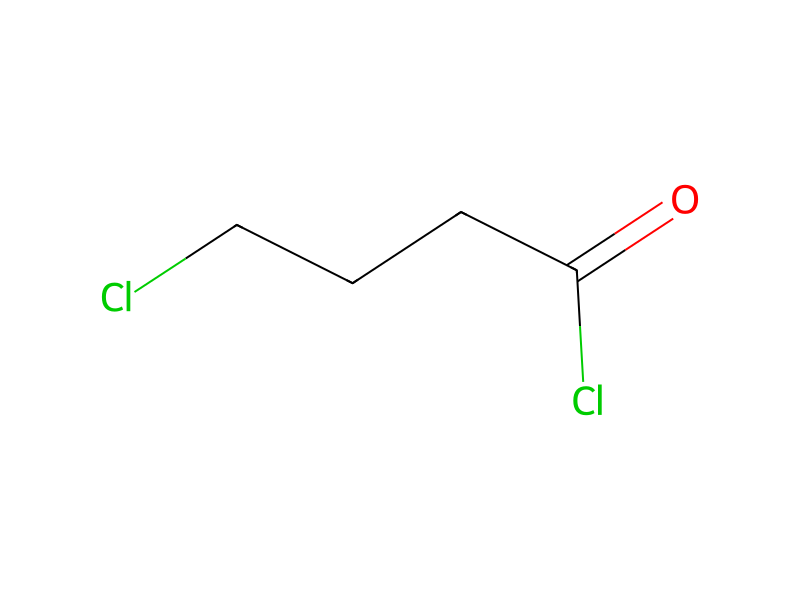
4-Chlorobutyryl chloride → HCID 22319500, compound
Reaction equation

[Cl:1][CH2:2][CH2:3][CH2:4][C:5](Cl)=[O:6].[Cl:8][C:9]1[CH:17]=[C:16]2[C:12]([C:13]([NH2:18])=[N:14][NH:15]2)=[CH:11][CH:10]=1>N1C=CC=CC=1>[Cl:1][CH2:2][CH2:3][CH2:4][C:5]([NH:18][C:13]1[C:12]2[C:16](=[CH:17][C:9]([Cl:8])=[CH:10][CH:11]=2)[NH:15][N:14]=1)=[O:6]Participants
Reactant 2

Product 1

Reagents, catalysts & solvents 1

Conditions
- Temperature
- 6 °C
Procedure
0.67 cm3 of 4-chlorobutyryl chloride is added to 1 g of 6-chloro-1H-indazole-3-amine in 15 cm3 of pyridine, after cooling to about 6° C. in an ice bath, and the mixture is then allowed to return to room temperature over 19 hours. The reaction medium is concentrated to dryness under reduced pressure (2 kPa; 45° C.) and the residue is taken up in 25 cm3 of ethyl acetate and 25 cm3 of water. The precipitate is filtered off and rinsed with 15 cm3 of ethyl acetate and 5 cm3 of dichloromethane. The organic phase is dried over magnesium sulphate, filtered and then concentrated to dryness under reduced pressure (2 kPa; 45° C.); after drying (90 Pa; 50° C.), 343 mg of 4-chloro-N-(6-chloro-1H-indazol-3-yl)butanamide are obtained in the form of a pale yellow solid melting at 220° C.
Workup
- concentrationThe reaction medium is concentrated to dryness under reduced pressure (2 kPa; 45° C.)
- filtrationThe precipitate is filtered off
- washrinsed with 15 cm3 of ethyl acetate and 5 cm3 of dichloromethane
- dry with materialThe organic phase is dried over magnesium sulphate
- filtrationfiltered
- concentrationconcentrated to dryness under reduced pressure (2 kPa; 45° C.)
- dry with materialafter drying (90 Pa; 50° C.), 343 mg of 4-chloro-N-(6-chloro-1H-indazol-3-yl)butanamide
Sources & evidence
- ORD record
- ord-2e9c2481d5ee4da18b86e8c2c9f5c1a2
- Source dataset
- uspto-grants-2005_09
- Patent number
- US06949579B2
Reaction notes
Loading…