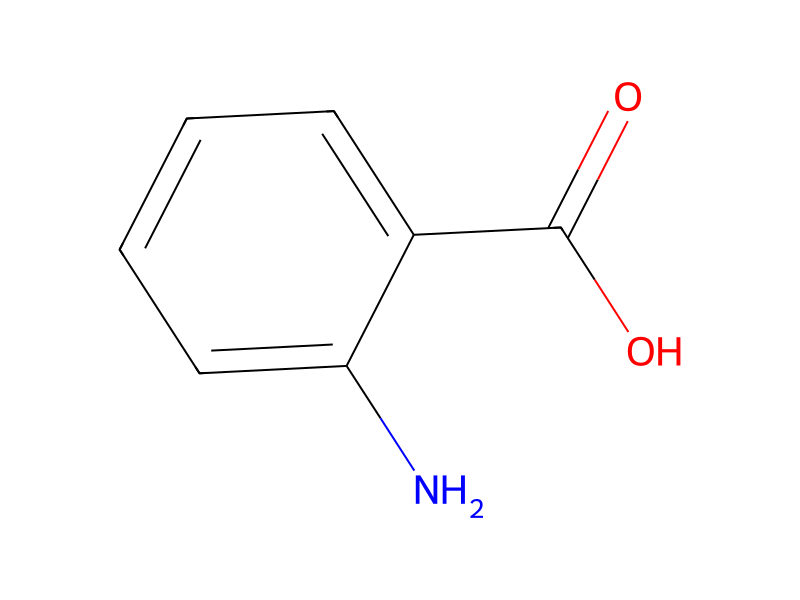
Anthranilic Acid → 2-(2-Oxo-propyl)-benzo[D][1,3]oxazin-4-one
Reaction equation

[C:1]([OH:10])(=[O:9])[C:2]1[C:3](=[CH:5][CH:6]=[CH:7][CH:8]=1)[NH2:4].[CH2:11]=[C:12]1[O:16][C:14](=O)[CH2:13]1.C(OC(=O)C)(=O)C>CC(C)=O.O1CCCC1>[O:16]=[C:12]([CH3:11])[CH2:13][C:14]1[O:9][C:1](=[O:10])[C:2]2[CH:8]=[CH:7][CH:6]=[CH:5][C:3]=2[N:4]=1Participants
Reactant 3


Product 1

Reagents, catalysts & solvents 2


Procedure
To a solution of anthranilic acid (290 g, 2.1 mol) in acetone (1000 mL), diketene (460 mL, 6.0 mol) was added dropwise at room temperature. The mixture was stirred at room temperature for 16 hours. The resulting crystals were collected by filtration, washed with acetone and diethylether, and air dried (170 g). The crude crystals were suspended in a mixture of acetic anhydride (320 mL, 3.4 mol) and tetrahydrofuran (1000 mL), and the mixture was heated and stirred at 80° C. for 12 hours. After the mixture was cooled to room temperature, the reaction solvents were evaporated under reduced pressure, and the resulting crude crystals were filtered. The crystals were washed with acetonitrile and air dried to give the title compound (244 g, 57% yield).
Workup
- filtrationThe resulting crystals were collected by filtration
- washwashed with acetone and diethylether, and air
- customdried (170 g)
- temperaturethe mixture was heated
- stirringstirred at 80° C. for 12 hours
- temperatureAfter the mixture was cooled to room temperature
- customthe reaction solvents were evaporated under reduced pressure
- filtrationthe resulting crude crystals were filtered
- washThe crystals were washed with acetonitrile and air
- customdried
Sources & evidence
- ORD record
- ord-9444c165352141449cfc2a81f4157677
- Source dataset
- uspto-grants-2005_09
- Patent number
- US06949648B2
Reaction notes
Loading…