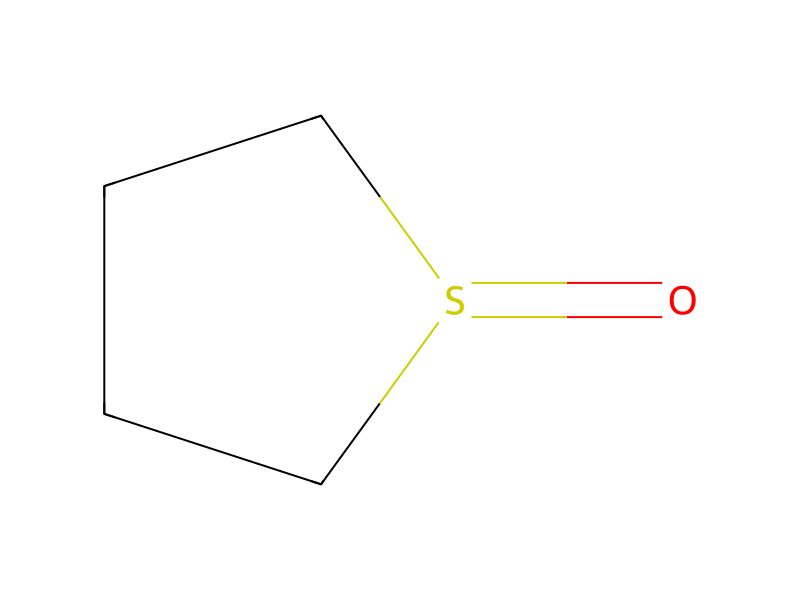
Tetramethylene sulfoxide → Propylene Glycol
Reaction equation

P([O:13][CH2:14][C@H:15]1[O:19][C@@H](N2C3N=C(N)NC(=O)C=3N=C2)[C@H:17](O)[C@@H:16]1O)(OP(OP(O)(O)=O)(O)=O)(=O)O.C1S(=O)CCC1.S1(CCCC1)(=O)=O>>[CH2:14]([OH:13])[CH:15]([OH:19])[CH2:16][CH3:17].[CH2:14]([OH:13])[CH:15]([OH:19])[CH3:16]Participants


Procedure
Investigations into the PCR enhancing capabilities of diol cosolvents were carried out using GTP as the primary template. This choice was made in order to provide the cosolvents with the greatest opportunity to demonstrate their effectiveness because GTP has the lowest GC content of the three templates used. Whether any diol is exclusively capable of amplifying c-jun at 92° C. was not investigated, since the diol family does not contain any member analogous to tetramethylene sulfoxide or sulfolane. The standard protocol for annealing temperature and concentration gradient screening was again followed. Additives were tested with GTP over annealing temperature gradients using a 95° C. denaturing temperature; 1,2-pentanediol and 1,2-hexanediol displayed detectable amplification only in very narrow concentration ranges, and trans-1,2-cyclopentanediol was inhibitory at all concentrations. These cosolvents were thus omitted from further studies. The optimal annealing temperatures for the remaining compounds were: ethylene glycol, 1,2-propanediol, 1,3-propanediol and cis-1,2-cyclopentanediol—58° C.; 1,2-butanediol—54° C.; 1,3-butanediol and 1,4-butanediol—60° C.; 2,4-pentanediol, 1,5-pentanediol, 1,6-hexanediol and MPD—56° C. The following concentration gradients were tested at these annealing temperatures: ethylene glycol—0.5, 1.0, 1.5, 2.0, 2.5, 3.0 and 4.5M; 1,2-propanediol—0.3, 0.5, 0.7, 0.9, 1.1, 1.4, 1.6, 1.8 and 2.0M; 1,3-propanediol—0.3, 0.5, 0.7, 0.9, 1.1 and 1.4M; 1,2-butanediol—0.1, 0.3, 0.5, 0.7, 0.8, 0.9 and 1.1M; 1,3-butanediol—0.2, 0.4, 0.5, 0.6, 0.7, 0.8, 1.0 and 1.1M; 1,4-butanediol—0.2, 0.4, 0.5, 0.6, 0.7, 0.8 and 1.0M; 1,5-pentanediol—0.1 to 0.6M in 0.1M intervals; 2,4-pentanediol—0.1 to 0.6 in 0.1M intervals; 1,6-hexanediol—0.05 to 0.35M in 0.05M intervals; MPD—0.1 to 0.5M in 0.1M intervals; cis-1,2-cyclopentanediol—0.05 to 0.3M in 0.05M intervals; glycerol—0.1 to 1.3M in 0.2M intervals. FIG. 4 shows results from the concentration gradients for 1,2-butanediol, 1,2-propanediol and glycerol. Potencies and effective ranges of the cosolvents are listed in Table 1. Virtually every diol studied provided nearly 100% specificity with GTP; thus, specificities are omitted from the table. Variation of amplification with concentration is displayed for 1,2-propanediol, 1,4-butanediol, 1,5-pentanediol and glycerol in FIG. 5. Splines for the three isomeric butanediols are shown in FIG. 6.
Workup
- customto provide the cosolvents with the greatest opportunity
- customis exclusively capable of amplifying c-jun at 92° C.
- concentrationThe standard protocol for annealing temperature and concentration gradient screening
- customusing a 95° C.
- concentration1,2-pentanediol and 1,2-hexanediol displayed detectable amplification only in very narrow concentration ranges, and trans-1,2-cyclopentanediol
- concentrationwas inhibitory at all concentrations
- customethylene glycol, 1,2-propanediol, 1,3-propanediol and cis-1,2-cyclopentanediol—58° C.
- custom1,2-butanediol—54° C.
- custom1,3-butanediol and 1,4-butanediol—60° C.
- custom2,4-pentanediol, 1,5-pentanediol, 1,6-hexanediol and MPD—56° C
- concentrationThe following concentration gradients
Sources & evidence
- ORD record
- ord-1747e4f9417745b2b7add651e727b906
- Source dataset
- uspto-grants-2010_08
- Patent number
- US07772383B2
Reaction notes
Loading…