2-Aminopyridine → HCID 718006, compound
Reaction equation

[CH3:1][O:2][C:3]1[CH:11]=[CH:10][C:6]([C:7]([OH:9])=O)=[CH:5][C:4]=1[N+:12]([O-:14])=[O:13].S(Cl)(Cl)=O.COC1C=CC(C(Cl)=O)=CC=1[N+]([O-])=O.[NH2:33][C:34]1[CH:39]=[CH:38][CH:37]=[CH:36][N:35]=1.CCN(C(C)C)C(C)C>ClCCl>[CH3:1][O:2][C:3]1[CH:11]=[CH:10][C:6]([C:7]([NH:33][C:34]2[CH:39]=[CH:38][CH:37]=[CH:36][N:35]=2)=[O:9])=[CH:5][C:4]=1[N+:12]([O-:14])=[O:13]Participants
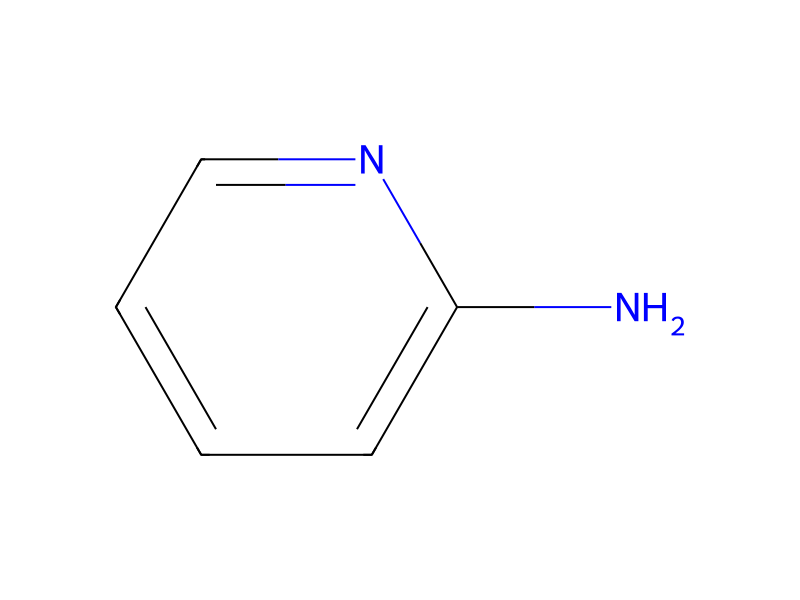






Procedure
4-methoxy-3-nitrobenzoic acid (10.0 g, 0.051 mol), and thionyl chloride (25 g, 0.212 mol), were refluxed together for 24 hours. The reaction mixture was cooled to room temperature and concentrated. The off-white solid was carried onto the next step. Step 2: 4-methoxy-3-nitrobenzoyl chloride (1.08 g, 0.005 mol), 2-aminopyridine (0.94 g, 0.01 mol) and DIPEA (1.8 mL, 0.01 mol) were allowed to stir in dichloromethane (10 mL) for 48 hours to form 4-methoxy-3-nitro-N-(pyridin-2-yl)benzamide. Intermediate was purified via silica column chromatography using 0 to 100% ethyl acetate in hexane. Step 3: Into a 100 mL round bottom flask was placed 4-methoxy-3-nitro-N-(pyridin-2-yl)benzamide (0.735 g, 2.69 mmol), 10% Palladium on carbon (250 mg), ethanol (50 mL), and acetic acid (10 mL) under inert atmosphere. Atmosphere then exchanged with hydrogen (via balloon) and allowed to stir 24 hours at room temperature. Reaction mixture was filtered through celite, concentrated under reduced pressure, then purified via silica column chromatography using 0 to 100% ethyl acetate in hexane. MS m/z=244 [M+H]+. Calc'd for C13H13N3O2: 243.3.
Workup
- concentrationconcentrated
Sources & evidence
- ORD record
- ord-1e617d08308e488cbb36993c60d39810
- Source dataset
- uspto-grants-2010_08
- Patent number
- US07776869B2
Reaction notes
Loading…