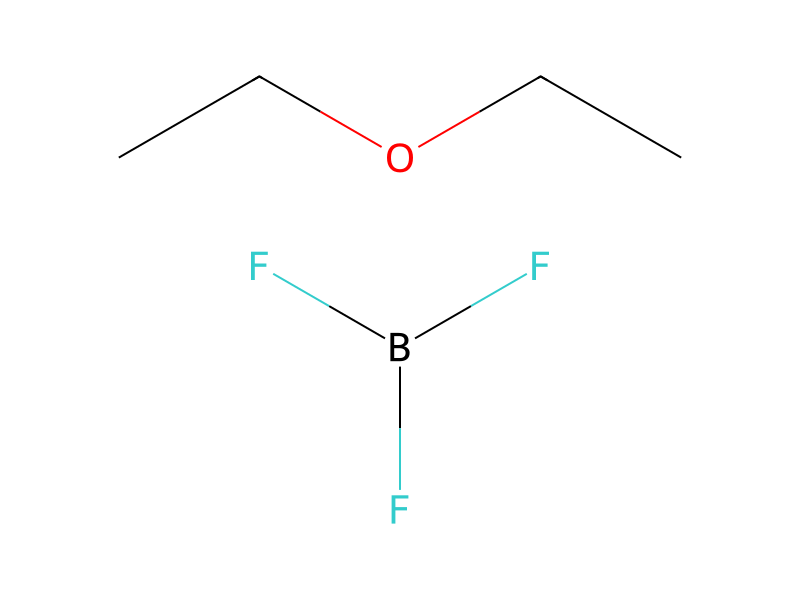
Boron trifluoride etherate → 8-Bromo-2,4-dioxo-bicyclo[3.2.2]non-8-ene-6-carboxylic acid methyl ester
Reaction equation

C[Si](C=[N+]=[N-])(C)C.[CH3:8][O:9][C:10]([CH:12]1[CH2:17][CH:16]2[C:18](=[O:21])[C:19](=[O:20])[CH:13]1[CH:14]=[C:15]2[Br:22])=[O:11].B(F)(F)F.[CH3:27]COCC>ClCCl>[CH3:8][O:9][C:10]([CH:12]1[CH2:17][CH:16]2[C:15]([Br:22])=[CH:14][CH:13]1[C:19](=[O:20])[CH2:27][C:18]2=[O:21])=[O:11]Participants
5
Reactant 3


Product 1

Reagents, catalysts & solvents 1

Conditions
- Temperature
- 20 °C
Procedure
4.2 ml of trimethylsilyl-diazomethane are added dropwise at a temperature of −10° C. to a solution of 1.91 g (7 mmol) of 5-bromo-7,8-dioxo-bicyclo[2.2.2]oct-5-ene-2-carboxylic acid methyl ester in 20 ml of dichloromethane and 0.089 ml (0.7 mmol) of boron trifluoride etherate. The cooling is removed and the reaction mixture is stirred for 4 hours at a temperature of 20° C. The reaction solution is then extracted with water, the organic phase is dried over sodium sulfate and concentrated by evaporation using a rotary evaporator, and the residue is purified by silica gel chromatography. An isomer of 8-bromo-2,4-dioxo-bicyclo[3.2.2]non-8-ene-6-carboxylic acid methyl ester is obtained.
Workup
- customThe cooling is removed
- extractionThe reaction solution is then extracted with water
- dry with materialthe organic phase is dried over sodium sulfate
- concentrationconcentrated by evaporation
- customa rotary evaporator
- customthe residue is purified by silica gel chromatography
Sources & evidence
- ORD record
- ord-2cabdc5d5af94cdea5ae208985a4530c
- Source dataset
- uspto-grants-2010_08
- Patent number
- US07776888B2
Reaction notes
Loading…