Isopropanol → 4-Bromo-alpha-phenylbenzeneacetic acid
Reaction equation

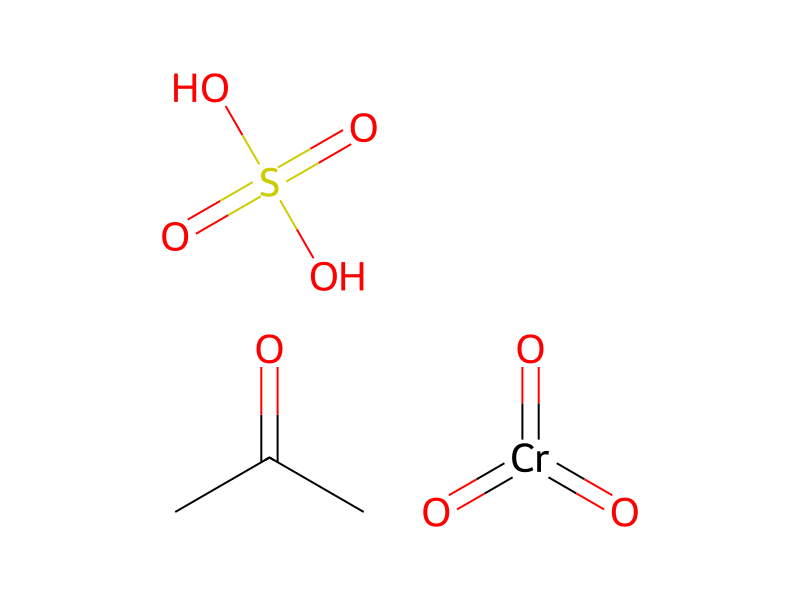
[Br:1][C:2]1[CH:7]=[CH:6][C:5]([CH:8]([C:11]2[CH:16]=[CH:15][CH:14]=[CH:13][CH:12]=2)[CH:9]=[O:10])=[CH:4][CH:3]=1.CC(C)=[O:19].OS(O)(=O)=O.O=[Cr](=O)=O.C(O)(C)C>CC(C)=O>[Br:1][C:2]1[CH:3]=[CH:4][C:5]([CH:8]([C:11]2[CH:12]=[CH:13][CH:14]=[CH:15][CH:16]=2)[C:9]([OH:19])=[O:10])=[CH:6][CH:7]=1Participants
5
Reactant 3


Product 1

Reagents, catalysts & solvents 1

Procedure
To a stirring solution of compound 52 (5.27 g, 19.15 mmol) in acetone (60 mL) cooled to −10° C. was added Jones Reagent (2.93 mL, 2.5 M solution) drop wise. Isopropyl alcohol was then added until the reaction mixture turned green. The mixture was filtered through Celite, diluted with ethyl acetate and washed with NaOH. The organic layer was discarded and the aqueous layer was acidified with 1M HCl to pH 1 and further extracted with ethyl acetate. The combined organics were dried over Na2SO4, filtered and concentrated to afford 2-(4-bromophenyl)-2-phenylacetic acid 53 (2 g, 36%) as a beige solid.
Workup
- filtrationThe mixture was filtered through Celite
- additiondiluted with ethyl acetate
- washwashed with NaOH
- extractionfurther extracted with ethyl acetate
- dry with materialThe combined organics were dried over Na2SO4
- filtrationfiltered
- concentrationconcentrated
Sources & evidence
- ORD record
- ord-cb98c5ac26e3467eb133816dbb14f7e3
- Source dataset
- uspto-grants-2015_08
- Patent number
- US09096565B2
Reaction notes
Loading…