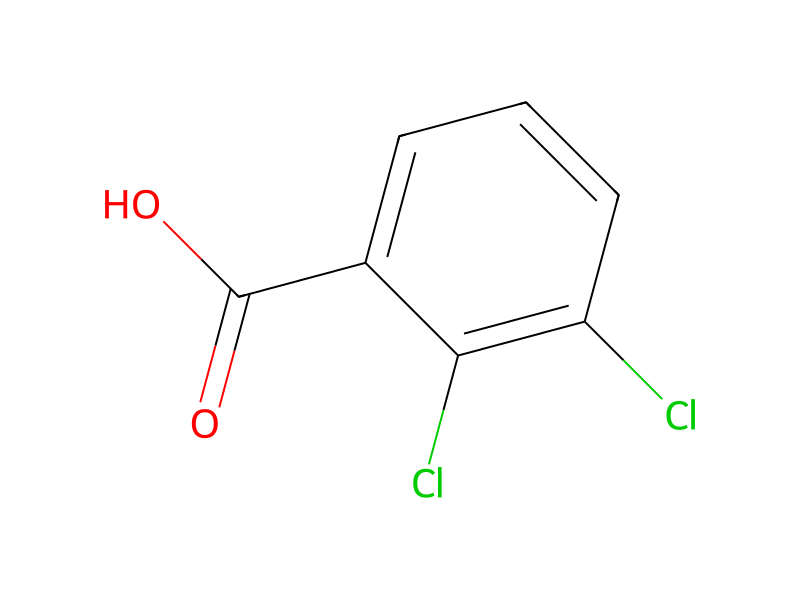
2,3-Dichlorobenzoic acid → HCID 86716340, compound
Reaction equation

[Cl:1][C:2]1[C:10]([Cl:11])=[CH:9][CH:8]=[CH:7][C:3]=1[C:4]([OH:6])=O.[NH2:12][CH2:13][CH:14]([C:19]1[CH:20]=[CH:21][C:22]([C:25]([OH:28])([CH3:27])[CH3:26])=[N:23][CH:24]=1)[CH2:15][CH:16]1[CH2:18][CH2:17]1>>[Cl:1][C:2]1[C:10]([Cl:11])=[CH:9][CH:8]=[CH:7][C:3]=1[C:4]([NH:12][CH2:13][CH:14]([C:19]1[CH:24]=[N:23][C:22]([C:25]([OH:28])([CH3:26])[CH3:27])=[CH:21][CH:20]=1)[CH2:15][CH:16]1[CH2:18][CH2:17]1)=[O:6]Participants
3


Procedure
The racemic mixture which was prepared in a similar manner to example 3a from 2,3-dichlorobenzoic acid and 2-(5-(1-amino-3-cyclopropylpropan-2-yl)pyridin-2-yl)propan-2-ol was separated into the two enantiomers by preparative SFC to yield the title compound. LCMS (MH+): m/z=407.1, tR (minutes, Method F)=1.98. [α]D20=+23.89 (c=3.0 mg/mL,CHCl3)
Workup
- customwas separated into the two enantiomers by preparative SFC
Sources & evidence
- ORD record
- ord-2d5bded8b16b43edb370fd9579e999a9
- Source dataset
- uspto-grants-2015_08
- Patent number
- US09102591B2
Reaction notes
Loading…