Oxalyl chloride → HCID 131733290, compound
Reaction equation
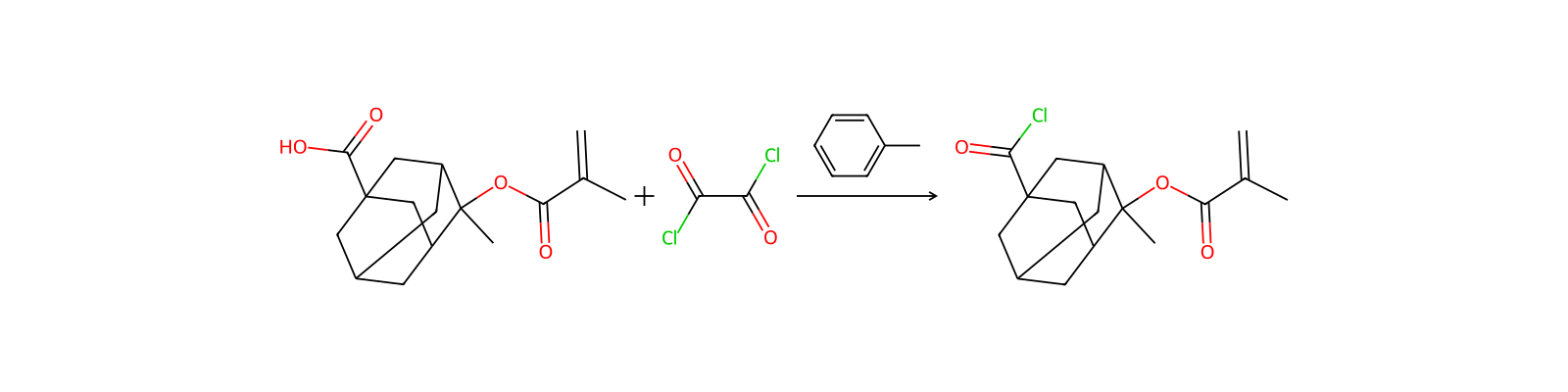
[C:1]([O:6][C:7]1([CH3:20])[CH:14]2[CH2:15][C:10]3([C:17](O)=[O:18])[CH2:11][CH:12]([CH2:16][CH:8]1[CH2:9]3)[CH2:13]2)(=[O:5])[C:2]([CH3:4])=[CH2:3].C(Cl)(=O)C([Cl:24])=O>C1(C)C=CC=CC=1>[C:1]([O:6][C:7]1([CH3:20])[CH:14]2[CH2:15][C:10]3([C:17]([Cl:24])=[O:18])[CH2:11][CH:12]([CH2:16][CH:8]1[CH2:9]3)[CH2:13]2)(=[O:5])[C:2]([CH3:4])=[CH2:3]Participants
Reactant 2


Product 1

Reagents, catalysts & solvents 1

Procedure
In toluene solvent, 4-methacryloyloxy-4-methyladamantanecarboxylic acid was reacted with oxalyl chloride into a corresponding carboxylic acid chloride. To 1.8 g (6 mmol) of 4-methacryloyloxy-4-methyladamantanecarboxylic acid chloride thus obtained, 2.5 g (5 mmol) of triphenylsulfonium 2-hydroxy-1,1,3,3,3-pentafluoropropane-1-sulfonate (which was synthesized with reference to JP-A 2007-145803) and 20 g of methylene chloride were added, followed by ice cooling. To the solution, a solution of 0.7 g (7 mmol) of triethylamine and 0.06 g (0.5 mmol) of N,N-dimethylaminopyridine in 5 g of methylene chloride was added at such a rate that the temperature might not exceed 10° C., followed by stirring for 12 hours at room temperature. Thereafter, 10 g of 5% dilute hydrochloric acid solution was added to the reaction solution. The organic layer was taken out and washed with water, whereupon methylene chloride was distilled off in vacuum.
Sources & evidence
- ORD record
- ord-d07bb803f38c40a6b1f6dc0a11b79feb
- Source dataset
- uspto-grants-2015_08
- Patent number
- US09104110B2
Reaction notes
Loading…