Ammonia → tert-butyl 3-(4-amino-5-iodo-7H-pyrrolo[2,3-d]pyrimidin-7-yl)azetidine-1-carboxylate
Reaction equation
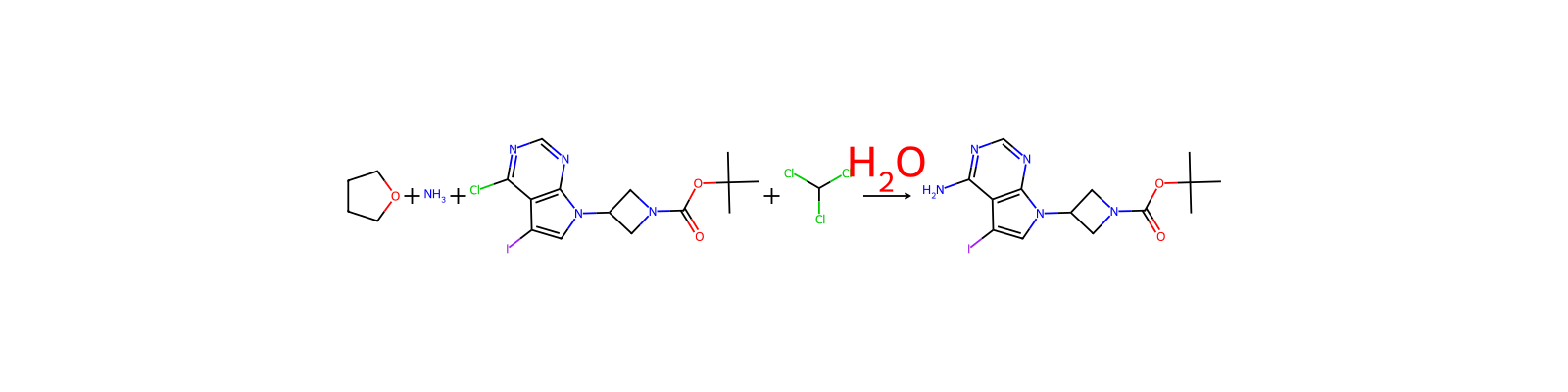
O1CCCC1.[NH3:6].Cl[C:8]1[C:9]2[C:16]([I:17])=[CH:15][N:14]([CH:18]3[CH2:21][N:20]([C:22]([O:24][C:25]([CH3:28])([CH3:27])[CH3:26])=[O:23])[CH2:19]3)[C:10]=2[N:11]=[CH:12][N:13]=1.C(Cl)(Cl)Cl>O>[NH2:6][C:8]1[C:9]2[C:16]([I:17])=[CH:15][N:14]([CH:18]3[CH2:21][N:20]([C:22]([O:24][C:25]([CH3:28])([CH3:27])[CH3:26])=[O:23])[CH2:19]3)[C:10]=2[N:11]=[CH:12][N:13]=1Participants
6
Reactant 4




Product 1

Reagents, catalysts & solvents 1

Conditions
- Temperature
- 100 °C
Procedure
Tetrahydrofuran (2.5 ml) and 28% aqueous ammonia (2.5 ml) were added to the tert-butyl 3-(4-chloro-5-iodo-7H-pyrrolo[2,3-d]pyrimidin-7-yl)azetidine-1-carboxylate (350 mg) obtained in Step 1 above. The reaction mixture was stirred at 100° C. for 1.5 hours using a microwave reactor. Chloroform and water were added thereto to separate the organic layer. The organic layer was dried over anhydrous sodium sulfate, and the solvent was distilled off under reduced pressure to obtain the title compound as a white solid (340 mg). Physical properties: m/z [M+H]+ 416.0
Workup
- customto separate the organic layer
- dry with materialThe organic layer was dried over anhydrous sodium sulfate
- distillationthe solvent was distilled off under reduced pressure
Sources & evidence
- ORD record
- ord-ae7c3d10dd264ce6aa3dcf1793734cac
- Source dataset
- uspto-grants-2015_08
- Patent number
- US09108973B2
Reaction notes
Loading…