Water → (S)-3-(4-Bromophenyl)cyclopentan-1-one
Reaction equation

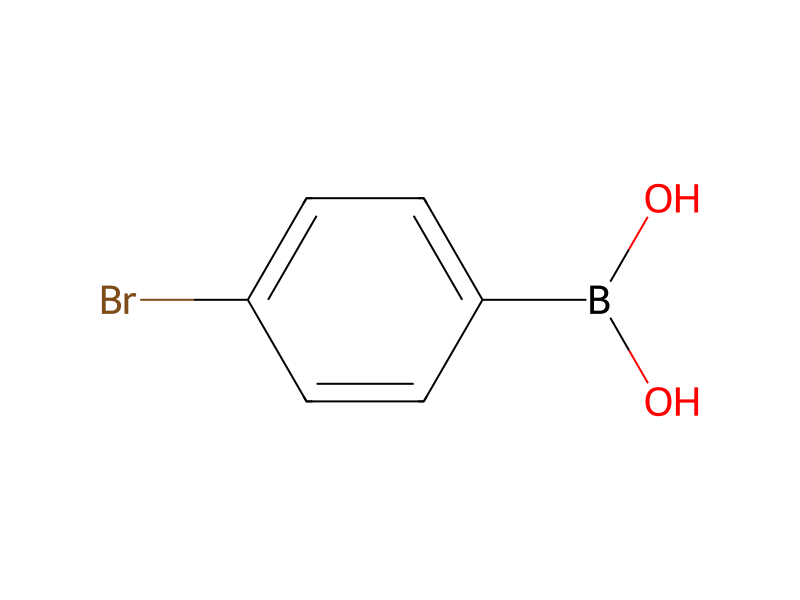
[Br:1][C:2]1[CH:7]=[CH:6][C:5](B(O)O)=[CH:4][CH:3]=1.O.[C:12]1(=[O:17])[CH2:16][CH2:15][CH:14]=[CH:13]1.CCN(CC)CC>O1CCOCC1.[B-](F)(F)(F)F.C1C2C=CC1C=C2.C1C2C=CC1C=C2.[Rh]>[Br:1][C:2]1[CH:7]=[CH:6][C:5]([C@H:14]2[CH2:15][CH2:16][C:12](=[O:17])[CH2:13]2)=[CH:4][CH:3]=1Participants
Reactant 4



Product 1

Reagents, catalysts & solvents 2


Procedure
A solution of 4-bromophenylboronic acid (20 g, 100 mmol) in 1,4-dioxane (120 mL) in a 500 ml flask was purged with nitrogen for 5 mins S-BINAP (0.992 g, 1.593 mmol) and bis(norbornadiene)rhodium (I) tetrafluoroborate (0.559 g, 1.494 mmol) were added sequentially to the solution under a positive pressure of nitrogen. After 2 hours of agitation at room temperature, water (20 mL) was added followed by cyclopent-2-enone (8.06 mL, 100 mmol) and Et3N (13.88 mL, 100 mmol). The mixture was allowed to stir at room temperature for 16 hours. The resulting dark solids were removed by filtration and the filtrate was poured into 250 ml of ethyl acetate. The solution was washed with water twice and the organic layer was concentrated. The residue was purified by flash column chromatography (split into two batches, each run on a 330 g silica column 0%-25% ethyl acetate in hexane) to afford 12.1 grams of (S)-3-(4-bromophenyl)cyclopentanone. HPLC purity was >98% and Chiral HPLC analysis indicated approximately 90% ee. The material was further purified under the Chiral SFC conditions described below. Experimental Details: Instrument: Berger SFC MGIII; Preparative Conditions Column: CHIRALPAK® AD-H 25×5 cm, 5 μm; Column Temperature: 40° C.; Flow rate: 200 mL/min; Mobile Phase: CO2/MeOH=80/20; Detector Wavelength: 225 nm; Injection Vol.: 1.0 mL; Sample Preparation: 12.1 g in; 210 mL MeOH (Conc. 60 mg/ml); Analytical Conditions: Column: CHIRALPAK® AD 25×0.46 cm, 10 μm; Column Temperature: 40° C.; Flow rate: 2.0 min; Mobile Phase: CO2/MeOH=70/30; Detector Wavelength: 220 nm; Injection Vol.: 5 μL.
Workup
- additionwere added sequentially to the solution under a positive pressure of nitrogen
- customThe resulting dark solids were removed by filtration
- additionthe filtrate was poured into 250 ml of ethyl acetate
- washThe solution was washed with water twice
- concentrationthe organic layer was concentrated
- customThe residue was purified by flash column chromatography (
- customsplit into two batches
Sources & evidence
- ORD record
- ord-c70ebc4f8af042fab5678bf9eadb5e48
- Source dataset
- uspto-grants-2015_08
- Patent number
- US09115054B2
Reaction notes
Loading…