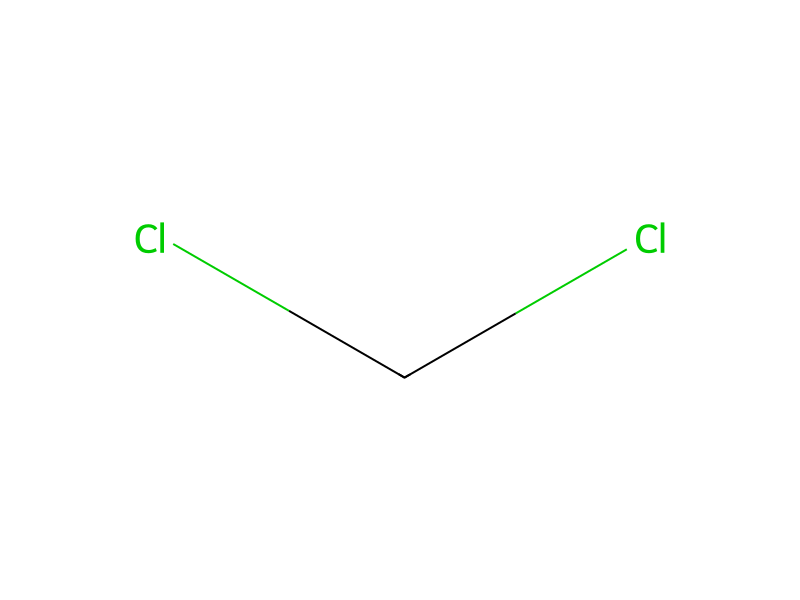
Dichloromethane → HCID 86666711, 화합물
반응식

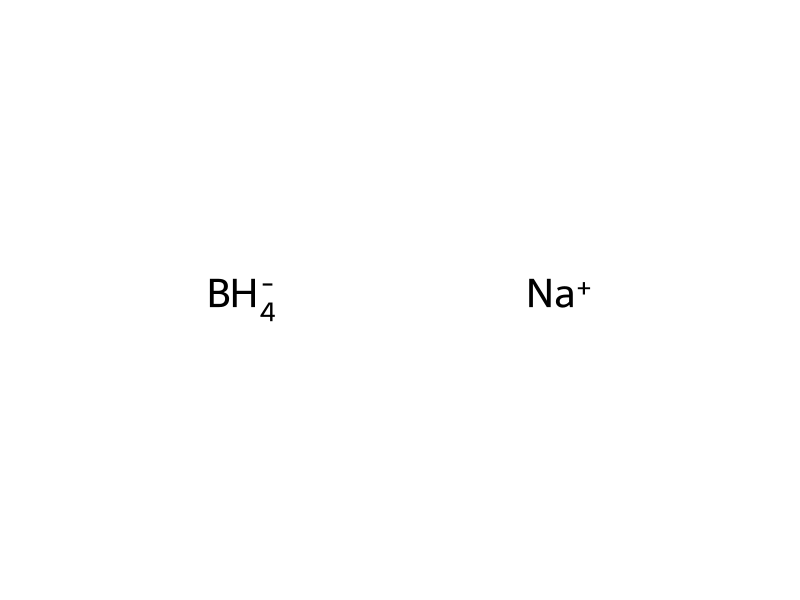
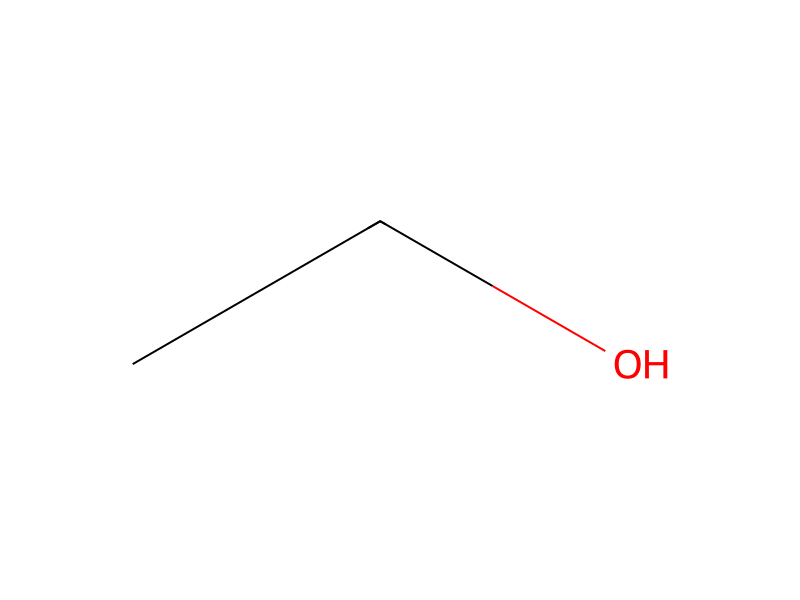
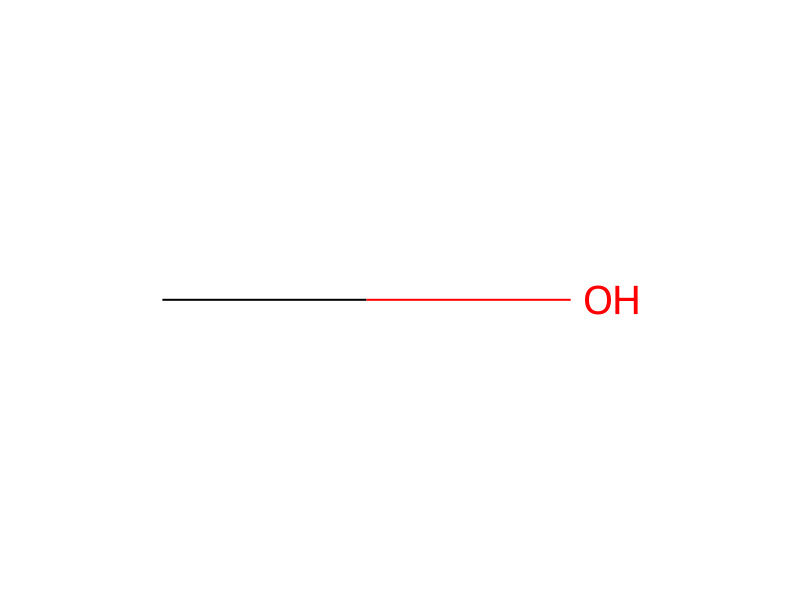
[C:1]([O:5][C:6]([NH:8][CH2:9][CH2:10][CH2:11][CH2:12][CH2:13][CH2:14][NH2:15])=[O:7])([CH3:4])([CH3:3])[CH3:2].[O:16]1[CH2:21][CH2:20][CH2:19][CH2:18][CH:17]1[O:22][CH2:23][CH2:24][C:25]1[CH:32]=[CH:31][C:28]([CH:29]=O)=[CH:27][CH:26]=1.[BH4-].[Na+].C(Cl)Cl>CCO.CO>[O:16]1[CH2:21][CH2:20][CH2:19][CH2:18][CH:17]1[O:22][CH2:23][CH2:24][C:25]1[CH:32]=[CH:31][C:28]([CH2:29][NH:15][CH2:14][CH2:13][CH2:12][CH2:11][CH2:10][CH2:9][NH:8][C:6](=[O:7])[O:5][C:1]([CH3:4])([CH3:3])[CH3:2])=[CH:27][CH:26]=1참가 물질



실험 절차
Freshly distilled 1d (5.80 g, 24.8 mmol) was weighed into a 250 mL 3-neck RB flask. Separately 3d (5.878 g, 25.17 mmol) was dissolved in 50 mL of absolute EtOH and the resultant solution added to the 250 mL RB reaction flask and the flask that contained 3d was washed out with 2×15 mL portions of absolute EtOH into the reaction flask. The reaction flask was then stoppered (side-arms) and attached to a double-layer coil condenser (centre-socket) which in turn was connected to a nitrogen-vacuum manifold and the apparatus then flushed with nitrogen. The reaction mixture was then stirred at room temperature under nitrogen overnight (19 hours). Next day 3-(diethylene-triamino)propyl-functionalised silica gel (5.84 g, 1.23 mmol/g loading) was added to the reaction mixture which was stirred at room temperature under nitrogen for a period of 6 hours in order to scavenge the excess 3d. Sodium borohydride (1.87 g, 49.4 mmol) was then added to the reaction mixture in a single portion and the mixture then stirred at room temperature overnight under an inert nitrogen atmosphere. Next day the reaction mixture was transferred to two balanced centrifuge tubes and spun down at a rate of 9000 rpm for a period of 10 minutes, the supernatant liquid was then decanted from the centrifuged solid (silica-gel) into a 500 mL florentine flask. The solid in each tube was then re-suspended in fresh EtOH (ca. 40 mL) and again spun down at 9000 rpm for 10 minutes and the supernatant liquid decanted into the evaporation flask before this process was repeated once more. The combined reaction mixture/washes was then concentrated in vacuo (rotary evaporator). De-ionised water (100 mL) was added to the residue in the evaporation flask forming a white emulsion. CH2Cl2 (100 mL) was added to the evaporation flask dissolving the white emulsion and forming two layers, aqueous and organic. The mixture was transferred to a 250 mL-separating funnel and shaken vigorously, the layer allowed to partition and then separated. The aqueous layer was then extracted with a further 2×100 mL portions of CH2Cl2, the layers partitioned and separated. The extracts were then combined and dried over anhydrous Na2SO4 for a period of 45 minutes before being filtered and the collected drying agent washed with 3×30 mL portions of CH2Cl2. The filtrate and washings were combined and stripped to dryness in vacuo (rotary evaporator) to yield a pale yellow colourless oil. A small aliquot of this material was analysed by TLC (10% MeOH/90% CHCl3) which indicated one dominant spot (rather faint and “crescent” shaped) at an Rf of ca. 0.55 with no other visible spot. This crude product was pre-loaded onto 12 g of Merck 60 (15-40 μm) silica gel and loaded onto a 80 mm diameter sinter loaded with Merck 60 (15-40 μm) silica gel to a depth of 57 mm. The column was then eluted using the following parameters: (i) time per fraction: 3.00 minutes; (ii) fraction volumes: 100 mL; (iii) elution gradient: 100-87% CHCl3 in 1% increments/0-13% MeOH in 1% increments (14 fractions). Fractions' 8-10 were a very pale “off-yellow” colour. Fractions' 8-11 were combined and stripped to dryness in vacuo (rotary evaporator) to yield a yellow oil which was then dried in vacuo (oil immersion pump) at 60° C. for a period of 6 hours. Yield: 9.438 g (87.7%, pale yellow oil). 1H NMR (CDCl3) δ 1.26-1.88 (s+m, 23H, [—C(CH3)3]Boc & [3×—CH2—]pyran & [4×—CH2-]hexamethylene], 2.60 (t, 2H, >NCH2—), 2.90 (t, 2H, ArCH2—), 3.09 (q, 2H, BocNHCH2—), 3.45 (m, 1H, [OCHaHb-]pyran), 3.60 (m, 1H, —OpyranCHaHb—), 3.75 (s+m, 3H, ArCH2N< & [OCHaHb-]pyran), 3.93 (m, 1H, —OpyranCHaHb), 4.50 (bs, 1H, BocNH—), 4.60 (m, 1H, [—OCHO-]pyran), 7.17-7.27 (m, 4H, ArH).
후처리
- washwas washed out with 2×15 mL portions of absolute EtOH into the reaction flask
- customattached to a double-layer coil condenser
- customthe apparatus then flushed with nitrogen
- additionNext day 3-(diethylene-triamino)propyl-functionalised silica gel (5.84 g, 1.23 mmol/g loading) was added to the reaction mixture which
- stirringwas stirred at room temperature under nitrogen for a period of 6 hours in order
- stirringthe mixture then stirred at room temperature overnight under an inert nitrogen atmosphere
- waitspun down at a rate of 9000 rpm for a period of 10 minutes
- customthe supernatant liquid was then decanted from the centrifuged solid (silica-gel) into a 500 mL florentine flask
- customThe solid in each tube was then re-suspended in fresh EtOH (ca. 40 mL)
- waitagain spun down at 9000 rpm for 10 minutes
- customthe supernatant liquid decanted into the evaporation flask before this process
- customThe combined reaction mixture/washes
- concentrationwas then concentrated in vacuo (rotary evaporator)
- additionDe-ionised water (100 mL) was added to the residue in the evaporation flask
- customforming a white emulsion
- dissolutiondissolving the white emulsion
- customforming two layers
- customseparating funnel
- stirringshaken vigorously
- customto partition
- customseparated
- extractionThe aqueous layer was then extracted with a further 2×100 mL portions of CH2Cl2
- customthe layers partitioned
- customseparated
- dry with materialdried over anhydrous Na2SO4 for a period of 45 minutes
- filtrationbefore being filtered
- customthe collected drying agent
- washwashed with 3×30 mL portions of CH2Cl2
- customstripped to dryness in vacuo (rotary evaporator)
- customto yield a pale yellow colourless oil
- washThe column was then eluted
- custom3.00 minutes
- wash(iii) elution gradient
- customstripped to dryness in vacuo (rotary evaporator)
- customto yield a yellow oil which
- customwas then dried in vacuo (oil immersion pump) at 60° C. for a period of 6 hours
출처 및 근거
- ORD 기록
- ord-ddb90658239d496fbbeb840596fda91c
- 출처 데이터셋
- uspto-grants-2015_08
- 특허 번호
- US09115063B2
반응 노트
불러오는 중…