Formaldehyde → HCID 56600137, compound
Reaction equation

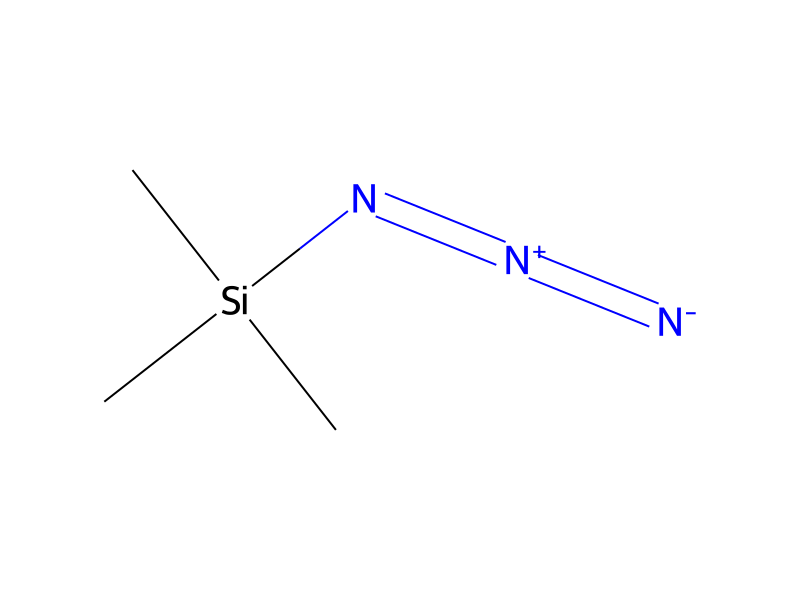
[CH2:1]=O.[NH:3]1[CH2:8][CH2:7][O:6][CH2:5][CH2:4]1.C[Si]([N:13]=[N+:14]=[N-:15])(C)C.[N+:16]([C:18]1[CH:23]=[CH:22][C:21]([C:24]([F:27])([F:26])[F:25])=[CH:20][N:19]=1)#[C-:17]>CO>[F:26][C:24]([F:27])([F:25])[C:21]1[CH:22]=[CH:23][C:18]([N:16]2[C:17]([CH2:1][N:3]3[CH2:8][CH2:7][O:6][CH2:5][CH2:4]3)=[N:15][N:14]=[N:13]2)=[N:19][CH:20]=1Participants
Reactant 4



Product 1

Reagents, catalysts & solvents 1

Procedure
To a solution of formaldehyde (37% in water) (0.043 ml, 0.581 mmol) in methanol (2 ml) was added morpholine (0.051 ml, 0.581 mmol). The reaction mixture was stirred at room temperature for 2 hours before the addition of trimethylsilylazide (0.077 ml, 0.581 mmol) and 2-isocyano-5-(trifluoromethyl)pyridine (100 mg, 0.581 mmol, commercially available from Priaxon AG, Munich, Germany). The reaction mixture was stirred at room temperature for 18 hours. The reaction mixture was partitioned between DCM (50 ml) and water (20 ml). The aqueous layer was extracted with DCM (50 ml). The organic layers were combined and passed through a phase separator, then concentrated. The residue was purified by MDAP. Relevant fractions were combined to afford the title compound as a light yellow solid (7 mg).
Workup
- customThe reaction mixture was partitioned between DCM (50 ml) and water (20 ml)
- extractionThe aqueous layer was extracted with DCM (50 ml)
- concentrationconcentrated
- customThe residue was purified by MDAP
Sources & evidence
- ORD record
- ord-5dac2ab2149a4b1b879a4011223a7db2
- Source dataset
- uspto-grants-2015_08
- Patent number
- US09115132B2
Reaction notes
Loading…