Carbon Dioxide → HCID 9793796, compound
Reaction equation

[C:1](=[O:4])([OH:3])[O-:2].[NH4+:5].C(=O)=O>O>[C:1](=[O:2])([OH:4])[O-:3].[NH4+:5].[C:1](=[O:2])([O-:4])[O-:3]Participants
Reactant 2

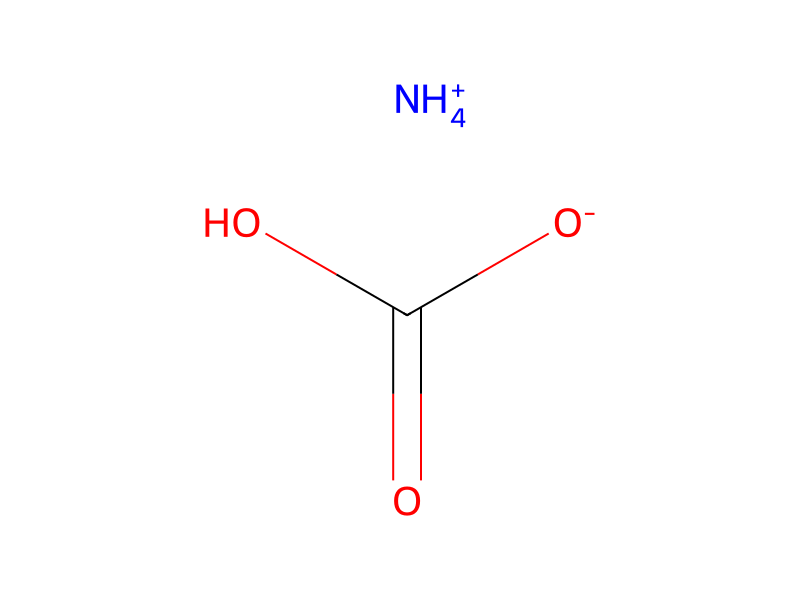
Product 1

Reagents, catalysts & solvents 1

Procedure
The process has been called the ABFX process since solid Ammonium Bicarbonate/carbonate is used rather than liquid or gaseous ammonia. In the ABFX process, the ammonium bicarbonate/carbonate solids are blended with the biomass at ambient pressure and temperature. The blended solids are then delivered to a pressure vessel at ambient pressure and temperature. The pressure vessel is then isolated (valve closed), and heated by a heat pump, microwave, or other heat source. Heating to temperatures of 40° C. to 60° C. vaporizes the ammonium bicarbonate/carbonate thus pressurizing the reactor and releasing the ammonia, water, and CO2 vapors. Each mole (79 g) of ammonium bicarbonate will produce 67 L of gas that pressurizes the vessel. The pressure is then released after a predetermined reaction period. The released ammonia, carbon dioxide, and water vapor are then cooled to ambient temperatures by natural or artificial means such as the chiller side of the heat pump. Upon cooling, the gas vapors precipitate to form solid ammonium bicarbonate/carbonate at ambient temperatures. The ABC solids are then blended with the influent biomass again, and so on. FIG. 1 presents a schematic of the ABFX process.
Workup
- customafter a predetermined reaction period
- temperatureUpon cooling
- customthe gas vapors precipitate
Sources & evidence
- ORD record
- ord-0d977e38aa0a410c8cee681433d2df72
- Source dataset
- uspto-grants-2016_05
- Patent number
- US09347074B1
Reaction notes
Loading…