Sodium Carbonate → HCID 23090642, compound
Reaction equation

[Cl:1][CH2:2][CH2:3][CH:4](C)[CH:5]=O.[CH:8]([O:15][CH2:16][CH3:17])([O:12][CH2:13][CH3:14])OCC.C([O-])([O-])=O.[Na+].[Na+]>O.C1(C)C=CC(S(O)(=O)=O)=CC=1.C(O)C>[CH2:16]([O:15][CH:8]([O:12][CH2:13][CH3:14])[CH:4]([CH3:5])[CH2:3][CH2:2][Cl:1])[CH3:17]Participants

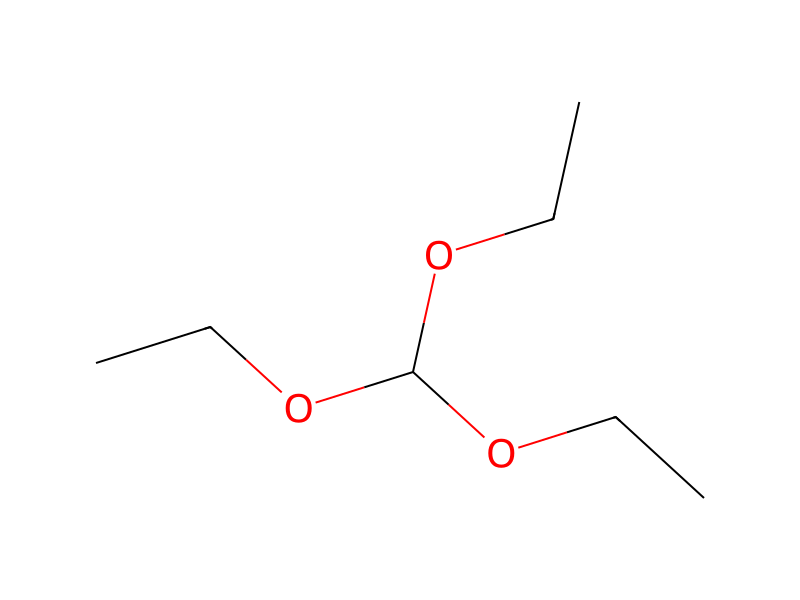



Conditions
- Temperature
- 45 °C
Procedure
A mixture of 4-chloro-2-methylbutyraldehyde (4.8 g, 0.040 moles), triethyl orthoformate (6.48 g, 0.044 moles), ethyl alcohol (3.0 g), and p-toluenesulfonic acid monohydrate (0.0144 g, 0.000757 moles) was stirred at 45° C. overnight under an argon atmosphere. Next, after cooling to room temperature, Na2CO3 (0.40 g) was added and the mixture was stirred for 15 min. The reaction mixture was filtered and ethyl alcohol and residual triethyl orthoformate were distilled off under reduced pressure. The residue was subjected to fractional vacuum distillation giving 3.2 g of pure 4-chloro-2-methylbutyraldehyde diethyl acetal. NMR (d6-DMSO): 0.85 ppm (d, —CH3, 3H) 1.13 ppm (m, —CH3, 6H), 1.52 ppm (m, —CH—, 1H), 1.87 ppm (m, —CH2CH2Cl, 2H), 3.35-3.75 ppm (bm, —OCH2CH3, 4H, and —CH2Cl, 2H), 4.22 ppm (d, —CH acetal, 1H).
Workup
- temperatureNext, after cooling to room temperature
- stirringthe mixture was stirred for 15 min
- filtrationThe reaction mixture was filtered
- distillationethyl alcohol and residual triethyl orthoformate were distilled off under reduced pressure
- distillationThe residue was subjected to fractional vacuum distillation
Sources & evidence
- ORD record
- ord-ee70eee346fc4337bdcbd8abcad0a85b
- Source dataset
- uspto-grants-2014_10
- Patent number
- US08853325B2
Reaction notes
Loading…