Pivaloyl chloride → ethyl 4-pivaloylbenzoate
Reaction equation

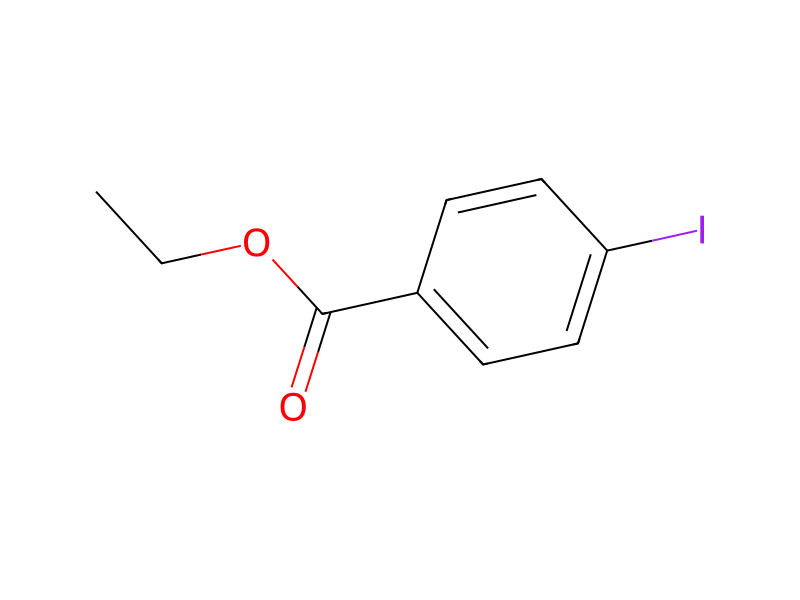
I[C:2]1[CH:12]=[CH:11][C:5]([C:6]([O:8][CH2:9][CH3:10])=[O:7])=[CH:4][CH:3]=1.[C:13](Cl)(=[O:18])[C:14]([CH3:17])([CH3:16])[CH3:15]>C1COCC1>[C:13]([C:2]1[CH:12]=[CH:11][C:5]([C:6]([O:8][CH2:9][CH3:10])=[O:7])=[CH:4][CH:3]=1)(=[O:18])[C:14]([CH3:17])([CH3:16])[CH3:15]Participants
Reactant 2

Product 1

Reagents, catalysts & solvents 1

Conditions
- Temperature
- 0 °C
Procedure
A round bottom flask was charged with the ethyl 4-iodobenzoate (10 g, 36 mmol) and THF (45 mL). Solution cooled down to 0° C. Turbo Grignard 1.3 M in THF (30.6 mL, 39.8 mmol) was then added in one portion and the reaction stirred for 30 minutes at 0° C. Pivaloyl chloride (5.35 mL, 43.5 mmol) was then charged in a second flask in THF (10 mL) and the preformed anion transferred via canula to the acyl chloride. The reaction was then slowly warmed to room temperature and stirred overnight. The reaction was quenched with ammonium chloride solution (sat. aq.) and extracted with ethyl acetate (2×), washed with brine (1×), dried over sodium sulfate, filtered and concentrated to provide ethyl 4-pivaloylbenzoate as a crude yellow gum (8.50 g). Used without further purification. 1H NMR (400 MHz, CDCl3) δ 1.30-1.36 (m, 9H) 1.42 (t, J=7.04 Hz, 3H) 4.40 (q, J=−7.24 Hz, 2H) 7.61-7.69 (m, 2H) 8.04-8.12 (m, 2H); MS (M): 234.
Workup
- temperatureThe reaction was then slowly warmed to room temperature
- stirringstirred overnight
- customThe reaction was quenched with ammonium chloride solution (sat. aq.)
- extractionextracted with ethyl acetate (2×)
- washwashed with brine (1×)
- dry with materialdried over sodium sulfate
- filtrationfiltered
- concentrationconcentrated
Sources & evidence
- ORD record
- ord-565d01bb35cb49688fc086f89c0671ba
- Source dataset
- uspto-grants-2014_10
- Patent number
- US08859591B2
Reaction notes
Loading…