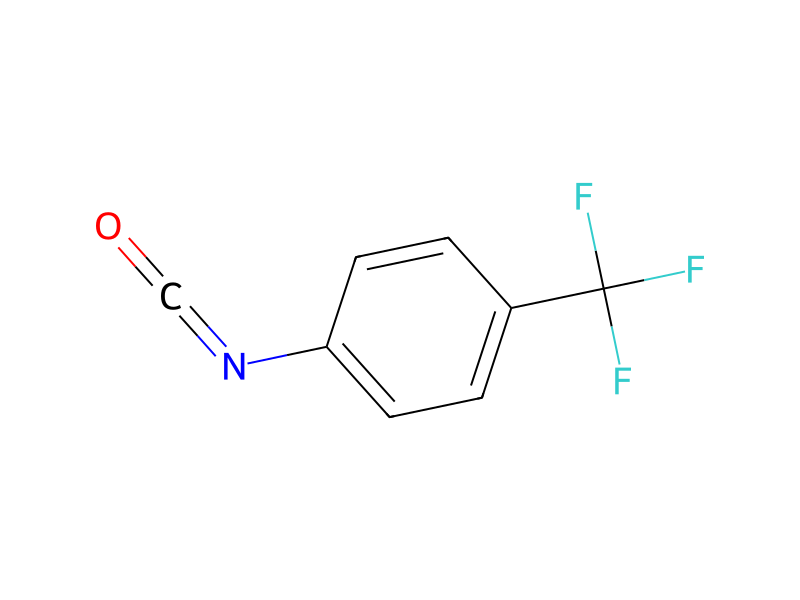
4-(Trifluoromethyl)phenyl isocyanate → HCID 11618718, compound
Reaction equation

[Cl:1][C:2]1[CH:6]=[N:5][N:4]([CH3:7])[C:3]=1[C:8]1[CH:9]=[C:10]([NH2:16])[CH:11]=[CH:12][C:13]=1[O:14][CH3:15].[F:17][C:18]([F:29])([F:28])[C:19]1[CH:24]=[CH:23][C:22]([N:25]=[C:26]=[O:27])=[CH:21][CH:20]=1>>[Cl:1][C:2]1[CH:6]=[N:5][N:4]([CH3:7])[C:3]=1[C:8]1[CH:9]=[C:10]([NH:16][C:26]([NH:25][C:22]2[CH:21]=[CH:20][C:19]([C:18]([F:17])([F:28])[F:29])=[CH:24][CH:23]=2)=[O:27])[CH:11]=[CH:12][C:13]=1[O:14][CH3:15]Participants
3


Procedure
3-(4-Chloro-2-methyl-2H-pyrazol-3-yl)-4-methoxy-phenylamine was treated with 4-trifluoromethylphenyl isocyanate in a similar manner as described in Example 1.53, providing 8 mg (15%) of Compound 80 (Note: Compound 80 did not precipitate out. Therefore, the CH2Cl2 was removed under reduced pressure, the residue was dissolved in 5 mL DMSO, and purified by preparative HPLC): LCMS m/z (%)=427 (M+H37Cl, 22), 425 (M+H35Cl, 100). 1H NMR (400 MHz, acetone-d6) δ: 8.48 (s, 1H), 8.24 (s, 1H), 7.56 (d, J=8 Hz, 2H), 7.50 (dd, J1=8 Hz, J2=2 Hz, 1H), 7.40 (d, J=8 Hz, 1H), 7.28 (d, J=4 Hz, 1H), 7.27 (s, 1H), 6.96 (d, J=12 Hz, 1H), 3.62 (s, 3H), 3.46 (s, 3H).
Sources & evidence
- ORD record
- ord-bc549bb23d0d4555beba3b6f83d5b173
- Source dataset
- uspto-grants-2014_10
- Patent number
- US08871797B2
Reaction notes
Loading…