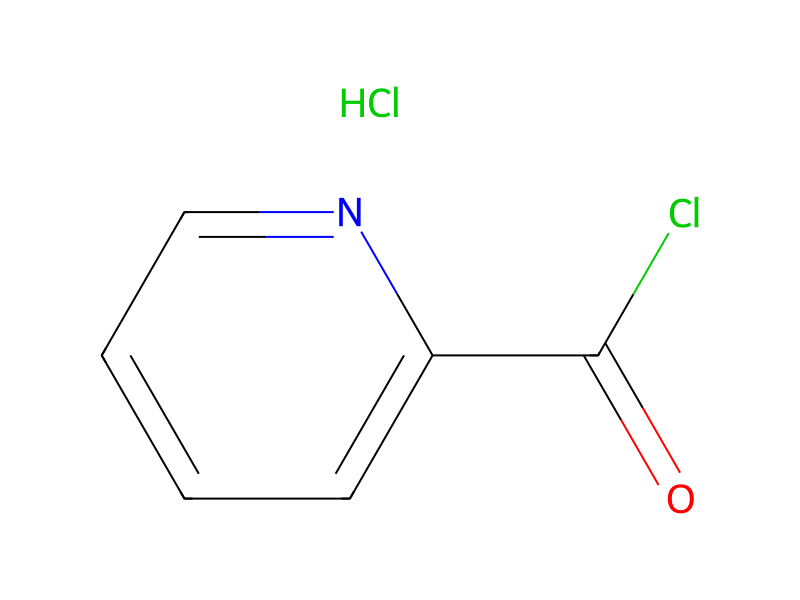
Picolinoyl Chloride Hydrochloride → HCID 57962706, compound
Reaction equation

[Cl:1][C:2]1[CH:3]=[N:4][C:5]2[NH:6][C:7]3[CH:8]=[CH:9][CH:10]=[C:11]([CH:23]=3)[CH2:12][NH:13][C:14]3[CH:22]=[C:18]([NH:19][C:20]=1[N:21]=2)[CH:17]=[CH:16][CH:15]=3.Cl.[N:25]1[CH:30]=[CH:29][CH:28]=[CH:27][C:26]=1[C:31](Cl)=[O:32]>>[Cl:1][C:2]1[CH:3]=[N:4][C:5]2[NH:6][C:7]3[CH:8]=[CH:9][CH:10]=[C:11]([CH:23]=3)[CH2:12][N:13]([C:31]([C:26]3[CH:27]=[CH:28][CH:29]=[CH:30][N:25]=3)=[O:32])[C:14]3[CH:22]=[C:18]([NH:19][C:20]=1[N:21]=2)[CH:17]=[CH:16][CH:15]=3Participants
3


Procedure
The desired compound was prepared as a white powder according to the procedure of Example C22, step F, using 6-chloro-2,4,8,14,22-pentaazatetracyclo[14.3.1.1(3,7).1(9,13)]docosa-1(20),3(22),4,6,9(21),10,12,16,18-nonaene and pyridine-2-carbonyl chloride hydrochloride as the starting materials in 29% yield. LCMS for C23H18ClN6O (M+H)+: m/z=429.0.
Sources & evidence
- ORD record
- ord-8f7842438e5f4180a8413a6f3173ff1b
- Source dataset
- uspto-grants-2014_10
- Patent number
- US08871753B2
Reaction notes
Loading…