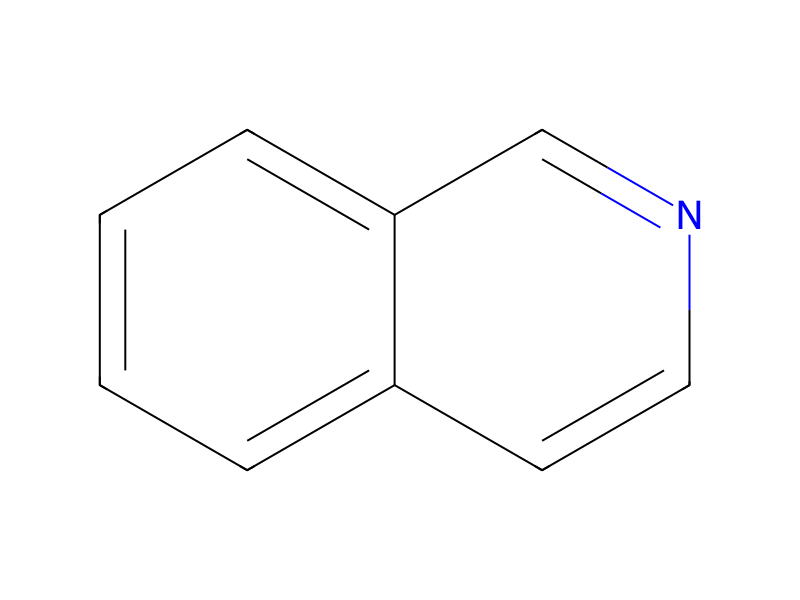
Isoquinoline → 1,2,3,4-Tetrahydroisoquinoline
Reaction equation

[CH:1]1[C:10]2[C:5](=[CH:6][CH:7]=[CH:8][CH:9]=2)[CH:4]=[CH:3][N:2]=1>[Ni]>[CH2:1]1[C:10]2[C:5](=[CH:6][CH:7]=[CH:8][CH:9]=2)[CH2:4][CH2:3][NH:2]1Participants
3
Reactant 1
Product 1

Reagents, catalysts & solvents 1

Procedure
In an autoclave, 1.2 kg of the same crude isoquinoline as used in Example 2 and 180 g of the aforementioned stabilized nickel catalyst were subjected to hydrogenation at a temperature of 180° C. under a hydrogen pressure of 135 kg/cm2 ·G for 65 hours. The amount of hydrogen absorbed was 29.9 moles and the molar ratio of the hydrogen absorption (by molar ratio based on raw material) was 3.22. The resultant reaction mixture was separated by filtration and then distilled. Consequently, 1.1 kg of 1,2,3,4-tetrahydroisoquinoline (purity 94.6% and total sulfur content 0%) was obtained.
Workup
- customwere subjected to hydrogenation at a temperature of 180° C. under a hydrogen
- custom·G for 65 hours
- customThe amount of hydrogen absorbed
- customthe molar ratio of the hydrogen absorption (by molar ratio based on raw material)
- customThe resultant reaction mixture
- customwas separated by filtration
- distillationdistilled
Sources & evidence
- ORD record
- ord-7d2fcae834414187ba19235ee2420fe2
- Source dataset
- uspto-grants-1987_04
- Patent number
- US04656279
Reaction notes
Loading…