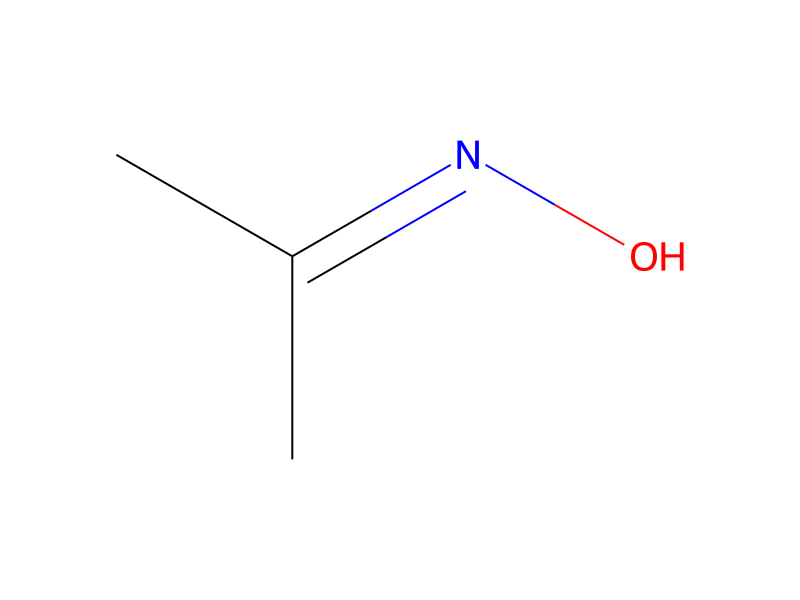
Acetone, oxime → HCID 13732595, compound
Reaction equation

[CH3:1][C:2](=[N:4][OH:5])[CH3:3].CC(C)([O-])C.[K+].[C:12]([C:20]1[C:21](Cl)=[C:22]2[CH:28]=[N:27][N:26]([CH2:29][CH3:30])[C:23]2=[N:24][CH:25]=1)(=[O:19])[C:13]1[CH:18]=[CH:17][CH:16]=[CH:15][CH:14]=1>O1CCCC1>[C:12]([C:20]1[C:21]([O:5][N:4]=[C:2]([CH3:3])[CH3:1])=[C:22]2[CH:28]=[N:27][N:26]([CH2:29][CH3:30])[C:23]2=[N:24][CH:25]=1)(=[O:19])[C:13]1[CH:14]=[CH:15][CH:16]=[CH:17][CH:18]=1Participants
5
Reactant 3


Product 1

Reagents, catalysts & solvents 1

Procedure
In 25 ml of dry tetrahydrofuran (THF hereafter) was dissolved 1.6 g of acetone oxime, followed by 2.46 of potassium t-butoxide. After stirring 0.5 hour 5.0 g of 5-benzoyl-4-chloro-1-ethyl-1H-pyrazolo[3,4-b]pyridine in 50 ml of THF was added to the solution. After an additional 0.5 hour the reaction was quenched with ammonium chloride solution and the product was extracted with ether. Evaporation of the organic phase and recrystallization of the residue from ethanol gave 4.1 g of product, mp 115°-116° C.
Workup
- additionwas added to the solution
- customAfter an additional 0.5 hour the reaction was quenched with ammonium chloride solution
- extractionthe product was extracted with ether
- customEvaporation of the organic phase and recrystallization of the residue from ethanol
Sources & evidence
- ORD record
- ord-f07f2c410c744692b362dfb018c5e4b9
- Source dataset
- uspto-grants-1987_04
- Patent number
- US04658029
Reaction notes
Loading…