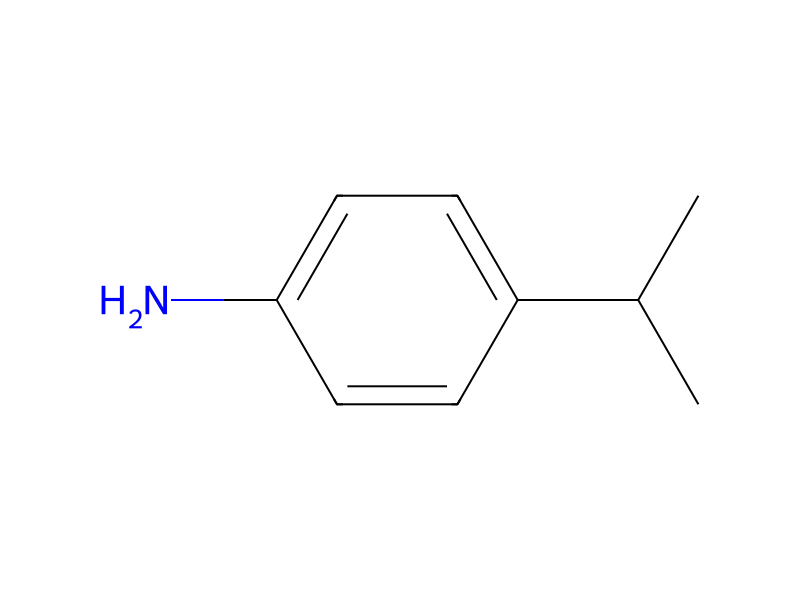
4-Isopropylaniline → HCID 13121218, compound
Reaction equation

Cl[C:2]1[C:7]([CH3:8])=[C:6]([CH3:9])[N:5]=[CH:4][N:3]=1.[CH:10]([C:13]1[CH:19]=[CH:18][C:16]([NH2:17])=[CH:15][CH:14]=1)([CH3:12])[CH3:11]>>[CH:10]([C:13]1[CH:19]=[CH:18][C:16]([NH:17][C:2]2[C:7]([CH3:8])=[C:6]([CH3:9])[N:5]=[CH:4][N:3]=2)=[CH:15][CH:14]=1)([CH3:12])[CH3:11]Participants


Procedure
To 3.6 g (0.025 mole) of 4-chloro-5,6-dimethylpyrimidine were added 3.4 g (0.025 mole) of p-isopropylaniline; the mixture was then heated at 100°-150° C. for about 3 minutes. The reaction mixture quickly became a solution and soon produced a precipitate, which was separated and then made alkaline by the addition of 50 ml of a dilute aqueous solution of sodium hydroxide. The mixture was then extracted with ethyl acetate and the extract was washed, in turn, with water and with a saturated aqueous solution of sodium chloride. It was then dried over anhydrous sodium sulphate and then the ethyl acetate was distilled off under reduced pressure, to give crystals, which, on recrystallisation froma 3:1 by volume mixture of benzene and hexane, gave 1.4 g (yield 23%) of the desired product in the form of very fine colourless needles melting at132°-133° C.
Workup
- temperaturethe mixture was then heated at 100°-150° C. for about 3 minutes
- customsoon produced a precipitate, which
- customwas separated
- additionby the addition of 50 ml of a dilute aqueous solution of sodium hydroxide
- extractionThe mixture was then extracted with ethyl acetate
- washthe extract was washed, in turn, with water and with a saturated aqueous solution of sodium chloride
- dry with materialIt was then dried over anhydrous sodium sulphate
- distillationthe ethyl acetate was distilled off under reduced pressure
- customto give crystals, which
- customon recrystallisation froma 3:1
- additionby volume mixture of benzene and hexane
Sources & evidence
- ORD record
- ord-74c327fdadc74d80b340c577c8ea9239
- Source dataset
- uspto-grants-1984_05
- Patent number
- US04450162
Reaction notes
Loading…