
4-Isopropylaniline
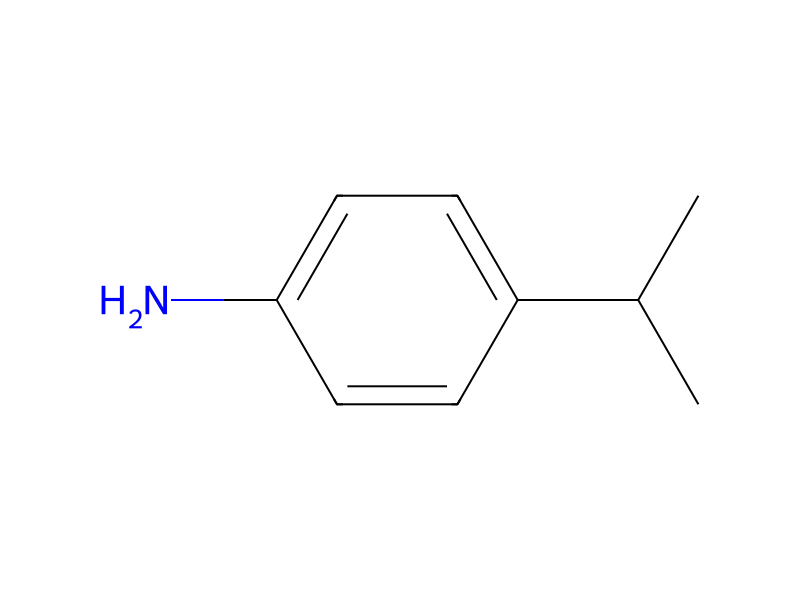
Basic information
- CAS
99-88-7- Standard SMILES
CC(C)c1ccc(N)cc1- InChIKey
LRTFPLFDLJYEKT-UHFFFAOYSA-N- Molecular formula
- C9H13N
- Average molar mass
- 135.21 g/mol
- Monoisotopic mass
- 135.10479942
Overview
Para-isopropylaniline is a substituted aniline carrying an isopropyl group at position 4. It is a metabolite of isoproturon. It has a role as a bacterial xenobiotic metabolite and a marine xenobiotic metabolite.
Names & identifiers
- Preferred name
- 4-Isopropylaniline
- IUPAC
- 4-propan-2-ylaniline
- English name
- 4-Isopropylaniline
- Molecular formula
- C9H13N
- Molecular weight
- 135.21
Names & synonyms
4-ISOPROPYLANILINE99-88-7Cumidine4-Aminocumenep-Isopropylanilinep-Cumidine4-Amino-1-isopropylbenzenePARA-ISOPROPYLANILINE4-propan-2-ylaniline4-(1-methylethyl)anilinebeta-(4-Aminophenyl)propane0D54T7V7XL
Show more names
4-Isopropyl-phenylaminecumidinCUMIDENE4-Cumidine4-AMINOCUMOLP-AMINOCUMENE
NSC-7198CHEBI:43405DTXSID20243932RefChem:579535DTXCID50166423202-797-2682-629-64-(Propan-2-Yl)Aniline
Database identifiers
- CAS
99-88-7- PubChem CID
- 7464
- DTXSID
DTXSID20243932- ChEBI
CHEBI:43405- UNII
- 0D54T7V7XL
- EC Number
- 202-797-2、682-629-6
- Nikkaji
- J11.624F
Properties
Computed structural properties
- XLogP
- 2.2
- Topological polar surface area
- 26 Ų
- Hydrogen bond donors
- 1
- Hydrogen bond acceptors
- 1
- Rotatable bonds
- 1
- Heavy atoms
- 10
- Formal charge
- 0
- Complexity
- 90.9
Experimental & physicochemical properties
Chemical ClassesNitrogen Compounds -> Amines, Aromatic
DrugsPharmaceuticals -> Listed in ZINC15
SpringerMaterials Properties13C nuclear magnetic resonance spectrum
Pesticides
Pesticide -> transformation product
Pesticides -> Herbicides -> Urea herbicides -> Phenylurea herbicides -> Transformation products
LogP2.31
Physical DescriptionLiquid; [Merck Index] Clear dark red liquid; [Sigma-Aldrich MSDS]
Physicochemical properties
- Melting point
- -63 °C · -63 °C
- Boiling point
- 224 °C · 224 °C
- Density
- 0.95 · 0.95
- vapor pressure
- 10 Pa · 10Pa at 20℃
- refractive index
- 1.54 · 1.54
Safety & regulation
Safety information is for reference only and does not replace the supplier’s Safety Data Sheet (SDS), applicable regulations, or professional assessment.
GHS classification
GHS Classification
Warning
H302 (16.7%): Harmful if swallowed [Warning Acute toxicity, oral]
P261, P264, P264+P265, P270, P271, P280, P301+P317, P302+P352, P304+P340, P305+P351+P338, P317, P319, P321, P330, P332+P317, P337+P317, P362+P364, P403+P233, P405, and P501 (click each P-code to see the statement)
Aggregated GHS information provided per 48 reports by companies from 8 notifications to the ECHA C&L Inventory. Each notification may be associated with multiple companies.
Warning
H315 (100%): Causes skin irritation [Warning Skin corrosion/irritation]
Hazard information
Regulatory Information
REACH registered substance: 4-isopropylaniline (EC: 202-797-2)
Benzenamine, 4-(1-methylethyl)-: Does not have an individual approval but may be used under an appropriate group standard
Hazards Summary
Hematological changes (including increased methemoglobin), increased spleen and liver weights, and histopathological changes of the bone marrow, spleen, and liver observed in oral repeated dose/reproductive/developmental study of rats with NOEL for parental animals of 6 mg/kg/day; This study also demonstrated decreased pup body weights and viability on day 4 of lactation but no evidence of reproductive toxicity; [JECDB] May induce methemoglobinemia; [IUCLID] Causes burns; Toxic by ingestion, inhalation, and skin absorption; [ECHA REACH Registrations] A skin and strong eye irritant; May induce methemoglobinemia; [Sigma-Aldrich MSDS]
Hazard Classes and Categories
Acute Tox. 4 (16.7%)
Skin Irrit. 2 (100%)
Flammable liquids - Category 4
Toxicology
Chemistry & industry
Uses & manufacturing
UsesUsed in the determination of tungsten; [Merck Index] Used in chemical synthesis; [IUCLID] Used to make fine and large scale chemicals; [ECHA REACH Registrations]
Use ClassificationPesticides -> Herbicides -> Urea herbicides -> Phenylurea herbicides -> Transformation products
Applications
Uses4-Isopropylaniline was used in the hydroamination of phenylacetylene.
General Description4-isopropylaniline is a metabolite of phenylurea herbicide isoproturon.
Upstream & downstream products
Upstream raw materials
Downstream products
Related reactions
245 records


Compound notes
Loading…