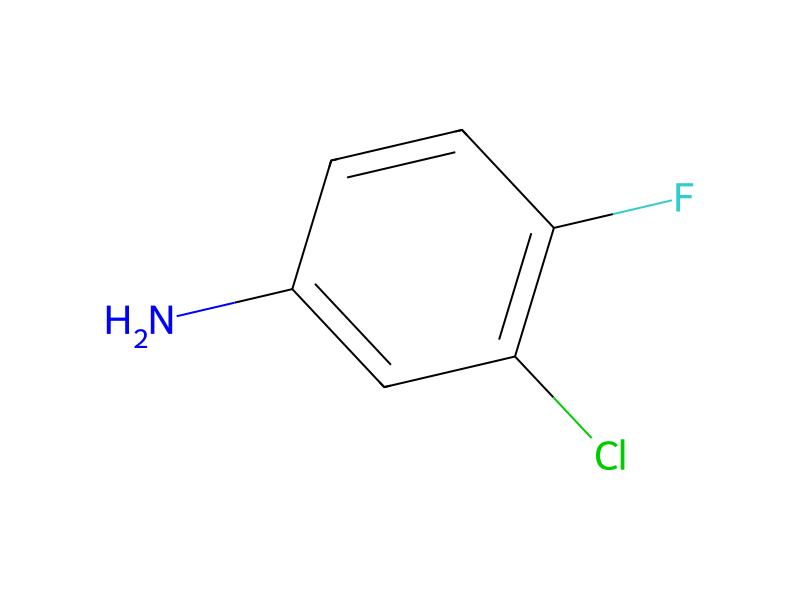
3-Chloro-4-fluoroaniline → 4-(3-Chloro-4-fluoroanilino)-7-chloro-6-nitro-3-quinolinecarbonitrile
Reaction equation

Cl[C:2]1[C:11]2[C:6](=[CH:7][C:8]([Cl:15])=[C:9]([N+:12]([O-:14])=[O:13])[CH:10]=2)[N:5]=[CH:4][C:3]=1[C:16]#[N:17].[Cl:18][C:19]1[CH:20]=[C:21]([CH:23]=[CH:24][C:25]=1[F:26])[NH2:22].Cl.N1C=CC=CC=1>CC(O)C>[Cl:18][C:19]1[CH:20]=[C:21]([CH:23]=[CH:24][C:25]=1[F:26])[NH:22][C:2]1[C:11]2[C:6](=[CH:7][C:8]([Cl:15])=[C:9]([N+:12]([O-:14])=[O:13])[CH:10]=2)[N:5]=[CH:4][C:3]=1[C:16]#[N:17]Participants
5



Procedure
A stirred mixture of 4,7-dichloro-6-nitro-3-quinolinecarbonitrile (10.7 g, 40 mmol), 3-chloro-4-fluoroaniline (7.0 g, 48 mmol), pyridine hydrochloride (4.6 g, 40 mmol), and 200 ml of 2-propanol was heated to reflux temperature and maintained for 1 h. The 2-propanol was evaporated off, and the residue was stirred in water with potassium bicarbonate (pH˜8). The resulting solid was filtered, washed with water and 5:1 hexane-DCM, and dried. Recrystallization from EtOH gave 11.3 g of yellow solid, mp 259-263°; ms 377.1 (M+H)+.
Workup
- temperaturewas heated
- temperatureto reflux temperature
- temperaturemaintained for 1 h
- customThe 2-propanol was evaporated off
- filtrationThe resulting solid was filtered
- washwashed with water and 5:1 hexane-DCM
- customdried
- customRecrystallization from EtOH
Sources & evidence
- ORD record
- ord-eff0d26f32224bfe9f0d7f3d17991444
- Source dataset
- uspto-grants-2011_05
- Patent number
- USRE042376E1
Reaction notes
Loading…