2,6-dichloro-N'-hydroxybenzene-1-carboximidamide → 1-({4-[3-(2,6-Dichlorophenyl)-1,2,4-oxadiazol-5-yl]piperidin-1-yl}carbonyl)-1,2,3,4-tetrahydroquinoline
Reaction equation

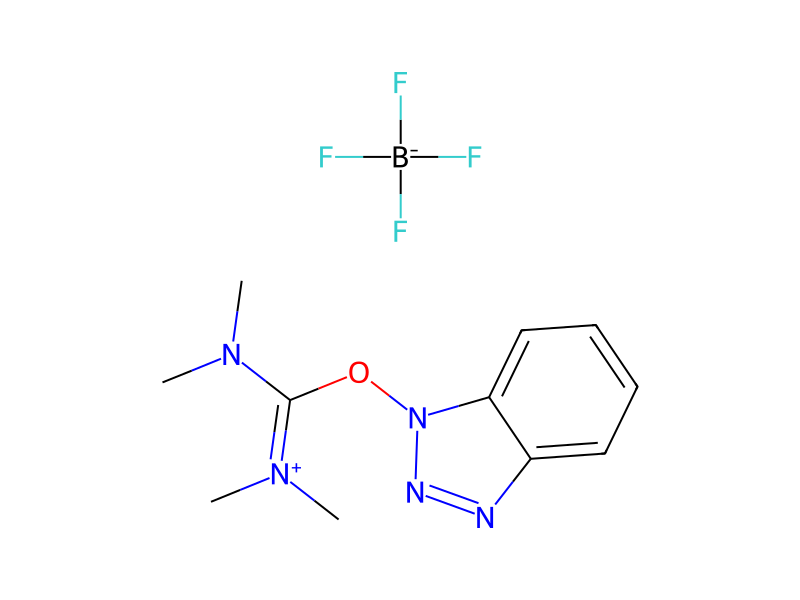
[N:1]1([C:11]([N:13]2[CH2:18][CH2:17][CH:16]([C:19](O)=[O:20])[CH2:15][CH2:14]2)=[O:12])[C:10]2[C:5](=[CH:6][CH:7]=[CH:8][CH:9]=2)[CH2:4][CH2:3][CH2:2]1.F[B-](F)(F)F.N1(OC(N(C)C)=[N+](C)C)C2C=CC=CC=2N=N1.ON1C2C=CC=CC=2N=N1.C(N(C(C)C)CC)(C)C.[Cl:63][C:64]1[CH:69]=[CH:68][CH:67]=[C:66]([Cl:70])[C:65]=1[C:71](=[N:73]O)[NH2:72]>O.CN(C)C=O>[Cl:63][C:64]1[CH:69]=[CH:68][CH:67]=[C:66]([Cl:70])[C:65]=1[C:71]1[N:73]=[C:19]([CH:16]2[CH2:17][CH2:18][N:13]([C:11]([N:1]3[C:2]4[C:7](=[CH:6][CH:5]=[CH:4][CH:3]=4)[CH2:8][CH2:9][CH2:10]3)=[O:12])[CH2:14][CH2:15]2)[O:20][N:72]=1Participants
Reactant 5




Product 1

Reagents, catalysts & solvents 2


Procedure
0.3 g of 1-(3,4-dihydroquinolin-1(2H)-ylcarbonyl)piperidine-4-carboxylic acid, 11 ml of dimethylformamide, 0.67 g of O-benzotriazol-1-yl-N,N,N′,N′-tetramethyluronium tetrafluoroborate, 0.028 g of 1-hydroxybenzotriazole, 0.91 ml of diisopropylethylamine and then 0.32 g of 2,6-dichloro-N′-hydroxybenzenecarboximidamide are introduced into a 100 ml round-bottomed flask. The reaction medium is stirred at ambient temperature for 1 h 30 and then heated at 95° C. for 20 hours. Water is added and the mixture is extracted with ethyl acetate. The organic phase is washed three times with water and dried over sodium sulfate and the solvent is evaporated under reduced pressure. The residue is chromatographed on silica gel with a heptane/ethyl acetate gradient from 0/1 to 1/1. 0.18 g of 1-({4-[3-(2,6-dichlorophenyl)-1,2,4-oxadiazol-5-yl]piperidin-1-yl}carbonyl)-1,2,3,4-tetrahydroquinoline is obtained.
Workup
- temperatureheated at 95° C. for 20 hours
- extractionthe mixture is extracted with ethyl acetate
- washThe organic phase is washed three times with water
- dry with materialdried over sodium sulfate
- customthe solvent is evaporated under reduced pressure
- customThe residue is chromatographed on silica gel with a heptane/ethyl acetate gradient from 0/1 to 1/1
Sources & evidence
- ORD record
- ord-dbda138097cc4f2faacfcf8f1e139397
- Source dataset
- uspto-grants-2011_05
- Patent number
- US07947834B2
Reaction notes
Loading…