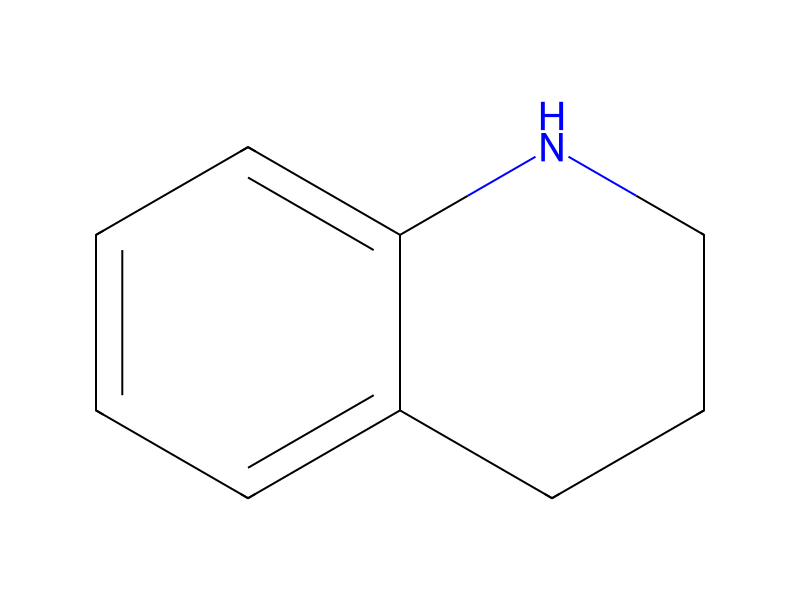
1,2,3,4-Tetrahydroquinoline → HCID 24852909, compound
Reaction equation

[NH:1]1[C:10]2[C:5](=[CH:6][CH:7]=[CH:8][CH:9]=2)[CH2:4][CH2:3][CH2:2]1.ClC(Cl)(O[C:15](=[O:21])OC(Cl)(Cl)Cl)Cl.[NH:23]1[CH2:28][CH2:27][CH:26]([C:29]2[CH:34]=[CH:33][N:32]=[CH:31][CH:30]=2)[CH2:25][CH2:24]1.C(=O)([O-])O.[Na+]>C(N(CC)CC)C.ClCCl>[N:23]1[CH:24]=[CH:25][C:26]([CH:29]2[CH2:34][CH2:33][N:32]([C:15]([N:1]3[C:10]4[C:5](=[CH:6][CH:7]=[CH:8][CH:9]=4)[CH2:4][CH2:3][CH2:2]3)=[O:21])[CH2:31][CH2:30]2)=[CH:27][CH:28]=1Participants






Procedure
0.12 g of 1,2,3,4-tetrahydroquinoline, 9 ml of dichloromethane and 0.16 ml of triethylamine are placed in a 50 ml round-bottomed flask under nitrogen atmosphere. 0.09 g of triphosgene is added at 0° C. and then the reaction mixture is left stirring at ambient temperature for 18 h. 0.147 g of 4-(piperidin-4-yl)pyridine is subsequently added and the reaction mixture is stirred for 60 h and then refluxed for 12 h. 20 ml of a saturated aqueous sodium hydrogencarbonate solution are added and then the aqueous phase is extracted three times with dichloromethane. The organic phases are combined and dried over sodium sulfate and the solvent is evaporated under reduced pressure. The residue is chromatographed on silica gel with a dichloromethane/methanol 95/5 mixture. 0.11 g of 1-[(4-(pyridin-4-yl)piperidin-1-yl)carbonyl]-1,2,3,4-tetrahydroquinoline is obtained.
Workup
- waitthe reaction mixture is left
- stirringthe reaction mixture is stirred for 60 h
- temperaturerefluxed for 12 h
- extractionthe aqueous phase is extracted three times with dichloromethane
- dry with materialdried over sodium sulfate
- customthe solvent is evaporated under reduced pressure
- customThe residue is chromatographed on silica gel with a dichloromethane/methanol 95/5 mixture
Sources & evidence
- ORD record
- ord-d1029664c13240b0b9403ba029da8550
- Source dataset
- uspto-grants-2011_05
- Patent number
- US07947834B2
Reaction notes
Loading…