Bromine → Ethyl 3-bromo-4-oxopiperidine-1-carboxylate
Reaction equation

[C:1]([N:6]1[CH2:11][CH2:10][C:9](=[O:12])[CH2:8][CH2:7]1)([O:3][CH2:4][CH3:5])=[O:2].[Br:13]Br>ClCCl>[C:1]([N:6]1[CH2:7][CH2:8][C:9](=[O:12])[CH:10]([Br:13])[CH2:11]1)([O:3][CH2:4][CH3:5])=[O:2]Participants
Reactant 2

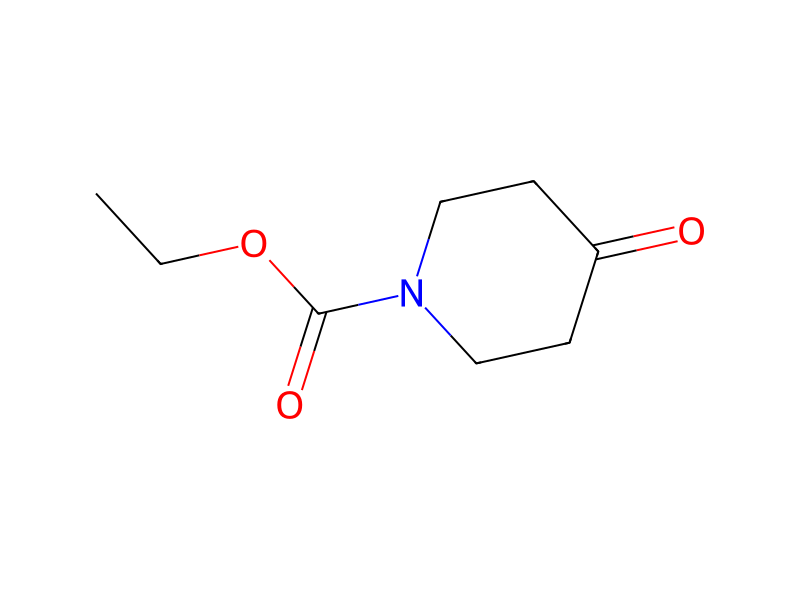
Product 1

Reagents, catalysts & solvents 1

Procedure
1-carbethoxy-4-piperidone 1 reacts with bromine in an inert solvent such as dichloromethane to give high yields of 1-carbethoxy-3-bromo-4-piperidone 2. The bromo compound 2 reacts with sodium methoxide in methanol to give 1-carbethoxy-3-hydroxy-4,4-dimethoxypiperidine 3, which in turn is alkylated to the corresponding 3-methoxy analog 4 with iodomethane in dimethylformamide in the presence of sodium hydride. The ketal 4 is hydrolyzed to 1-carbethoxy-3-methoxy-4-piperidone 5 by stirring in 1% sulfuric acid at room temperature. The amine 6 of cis-configuration is then readily obtained by reductive alkylation of 5 with benzylamine in the presence of hydrogen gas and 10% Pd/C with a small amount of thiophene. Further hydrogenolysis of the benzyl moiety with Pd/C and no thiophene gives the primary amine 7. Compound 7 in turn reacts with the commercially available 4-amino-5-chloro-2-methoxybenzoic acid in the presence of DCC and dimethyaminopyridine in dichloromethane to give the benzamide 8. Compound 8 is then hydrolyzed to the intermediate 9 with potassium hydroxide in ethanol/water.
Workup
- customto give high
Sources & evidence
- ORD record
- ord-fb658228f8aa4576b7489c7c4201ec41
- Source dataset
- uspto-grants-2011_05
- Patent number
- USRE042412E1
Reaction notes
Loading…