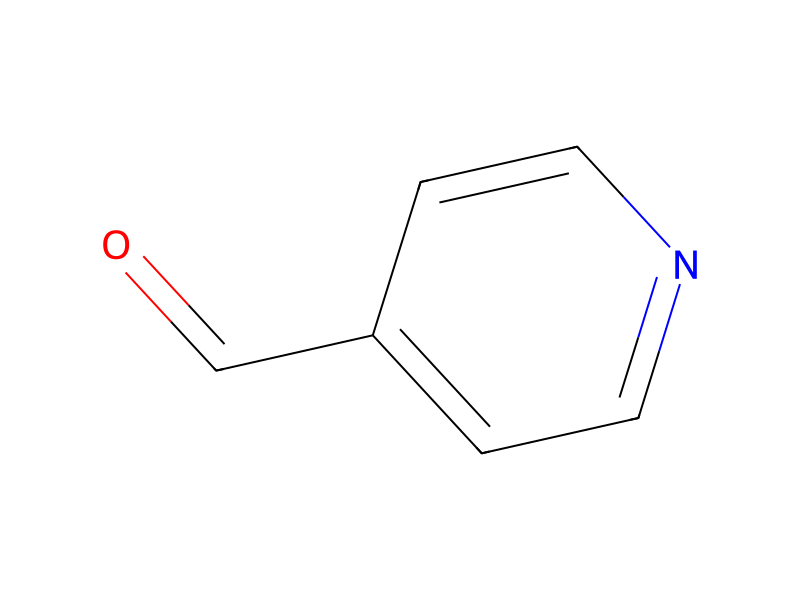
4-Pyridinecarboxaldehyde → HCID 58442023, compound
Reaction equation

[Cl:1][C:2]1[N:7]=[C:6]([NH:8][CH2:9][CH3:10])[C:5]([NH2:11])=[CH:4][N:3]=1.[N:12]1[CH:17]=[CH:16][C:15]([CH:18]=O)=[CH:14][CH:13]=1>CC(O)=O.CC(N(C)C)=O>[Cl:1][C:2]1[N:7]=[C:6]2[C:5]([N:11]=[C:18]([C:15]3[CH:16]=[CH:17][N:12]=[CH:13][CH:14]=3)[N:8]2[CH2:9][CH3:10])=[CH:4][N:3]=1Participants
4
Reactant 2

Product 1

Reagents, catalysts & solvents 1

Conditions
- Temperature
- 140 °C
Procedure
To a solution of 8.6 g (50 mmol, 1.0 eq.) of 2-chloro-N4-ethylpyrimidine-4,5-diamine (I-5) in 200 mL of 2% v/v AcOH/DMA was added 6.0 mL (65 mmol, 1.3 eq.) of 4-pyridine carboxaldehyde. The mixture was heated at 140° C. for 14 h. The mixture was allowed to cool to room temperature and the solvent was removed in vacuo. The residue was purified by preparative HPLC to provide 2.0 g (7.7 mmol, 15%) of 2-chloro-9-ethyl-8-(pyridin-4-yl)-9H-purine (I-6).
Workup
- temperatureto cool to room temperature
- customthe solvent was removed in vacuo
- customThe residue was purified by preparative HPLC
Sources & evidence
- ORD record
- ord-c39009a27461450a90a6a294dc740565
- Source dataset
- uspto-grants-2011_05
- Patent number
- US07951803B2
Reaction notes
Loading…